
Early development success hinges on compressing CMC timelines while controlling scientific and operational risk. Programs that integrate drug substance (DS) and drug product (DP) development within a single quality system and data backbone consistently reduce inter‑vendor idle time, analytical friction, and transfer risk. In early DS development, establishing alignment on route scouting, solid form, crystallization parameters, impurity profile, and particle attributes provides stable inputs for DP and helps prevent downstream surprises.
Multiple independent analyses now quantify the effect: single‑partner integration across development and clinical operations has been associated with timeline reductions and substantial financial upside from avoided delays due to transfers of knowledge and materials.
Multi‑vendor models (separate CRO, DS CMO, and DP/formulation partner) create cumulative delays from serial contracting, logistics, site release testing, and analytical method transfers. For DS specifically, every update to crystallization, milling, or impurity tracking must be requalified across vendors, increasing the risk of API spec mismatches (PSD, polymorph, residual solvent) and duplicated method.
Each inter‑site handoff introduces duplicated qualification and mismatch risk (methods, columns, solvents, system suitability), often pushing root‑cause investigations onto the critical path. Industry tech‑transfer literature and CDMO best‑practice guides consistently flag method transfer and knowledge gaps as primary delay drivers.
Solid‑State Control Links DS and DP
Modern small‑molecule candidates frequently present low aqueous solubility (often BCS Class II/IV) and solid‑state liabilities that are sensitive to processing conditions. Aragen integrates DS solid state work (salt/co crystal/polymorph selection, particle engineering) with formulation decisions from day one, in line with phase appropriate quality expectations. DS teams control crystallization parameters and particle attributes using PAT enabled approaches, feeding stable, well characterized API into DP to ensure manufacturability, blend uniformity, and dissolution performance.
Process choices at DP (e.g., wet granulation, drying, excipient micro‑environment) can trigger form transitions (anhydrous↔hydrate) or salt disproportionation; integrated DS–DP risk registers at Aragen align chemists, solid‑state scientists, and formulators to identify and mitigate these failure modes early.
Solubility/Developability Trends
A large proportion of NCEs in today’s pipelines are poorly water‑soluble, frequently requiring enabling formulation or solid‑state engineering. Trade and technical reviews commonly cite >70% of NCEs as poorly soluble, with a high share falling into BCS II/IV, underscoring the need for integrated physicochemical and formulation strategies.
Implication: Co‑located chemists, solid‑state scientists, and formulators can detect and resolve form or salt liabilities early (e.g., during salt selection, crystallization development, and process scale‑up), rather than discovering them during late stability or clinical supply manufacture.
What “FFP” Means in CMC
In early human studies, the objective is a safe, robust, and interpretable dosage form—not a commercial presentation. From the DS vantage point, this means delivering API with controlled solid form, consistent PSD, and a predictable impurity profile so that observed PK/PD reflects the molecule, not DS variability, DP then layers phase appropriate methods, stress testing, and stability commensurate with the dosing window.
Direct‑in‑Capsule (DiC) and Simple Liquids/Suspensions
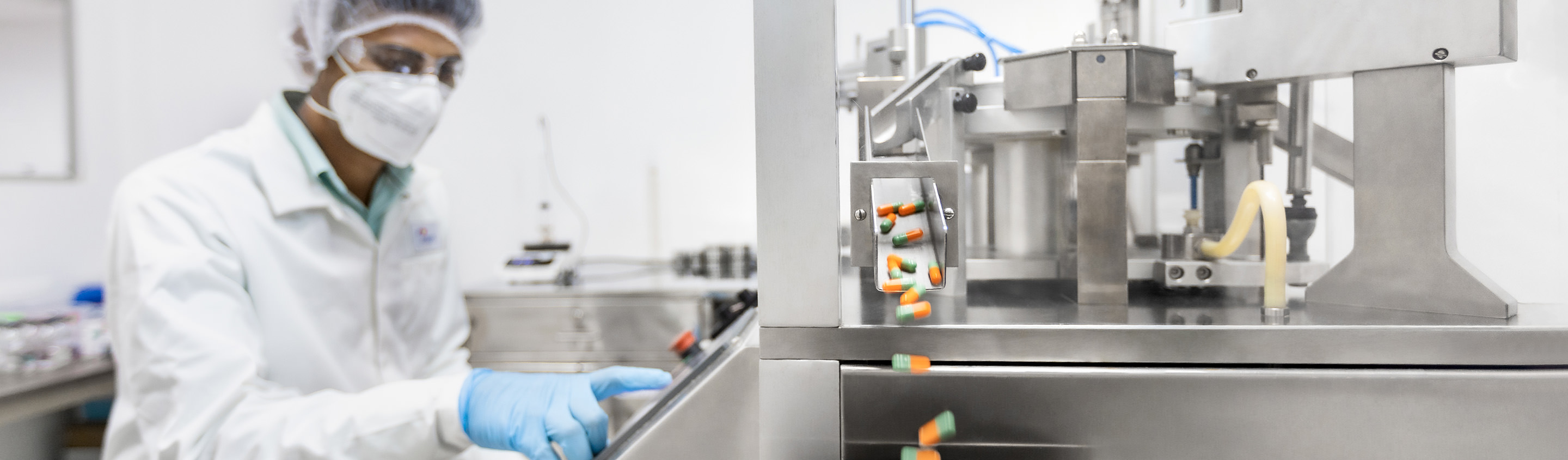
For many small molecules, API‑in‑capsule (powder‑in‑capsule) or simple solution/suspension presentations can eliminate months of development, accelerate tox‑to‑FIH supply, and preserve DS when API is scarce—provided the DS attributes (flow, density, PSD, stability) are aligned with micro-dosing and capsule fill requirements.
Aragen practice: We implement an FFP playbook (including DiC) to prioritize human PK/PD learning while controlling risk via phase‑appropriate method validation and short‑term stability aligned to clinical timelines.
Unified Quality Systems and Method Governance
Harmonized methods and a single quality framework reduce friction at DS↔DP interfaces (e.g., eliminating redundant site release testing and minimizing analytical discrepancies). Standard tech‑transfer frameworks stress the importance of structured document packs, defined decision‑rights, and proactive gap/risk assessment to avoid delays during scale‑up and GMP readiness.
Removing “hand-offs”
Integrated program management across DS, DP, clinical supply, and operations compresses non‑value‑added intervals—shipments, retesting, and re‑qualification cycles—that otherwise accumulate between vendors.
Aragen implementation: Our digital platform, InCoRe™ provides real‑time, cross‑functional visibility into DS/DP analytics, stability, and supply status while enforcing one set of SOPs and data standards across the workflow.
Table 1. Integrated DS-DP: Aragen Advantage.
| Feature | Traditional Multi‑Vendor | Aragen Integrated DS+DP |
| Contracting | Multiple MSAs, quality agreements, and audits | Single MSA; unified PMO and quality system; co‑located teams for DS–DP |
| Tech Transfer | Higher risk of analytical/method transfer failure and re‑qualification cycles | Single method governance, fewer inter‑site transfers; harmonized SOPs |
| Scientific Feedback Loop | Siloed decisions: limited DS↔DP cross‑talk | Continuous chemist–formulator–solid‑state collaboration from pre‑formulation onward |
| DS Inputs for DP | PSD/form control often revisited late | PAT‑enabled crystallization; early solid‑form/PSD control to stabilize DP manufacturability |
| Timeline to Clinic | 18–24 months typical for fragmented small‑molecule programs (varies widely) | 10–14 months achievable for integrated, phase‑appropriate approaches (program‑dependent) |
| Accountability & Data | Split among vendors; version friction | Single point of accountability; digital visibility (e.g., InCoRe) |
Backed by two decades of experience advancing small molecules into the clinic with phase‑appropriate CMC frameworks, Aragen offers the following integrated DS–DP strengths:
Outcome: Minimize inter‑vendor idle time, align DS properties with DP performance, and advance to human data faster—without compromising scientific rigor.
