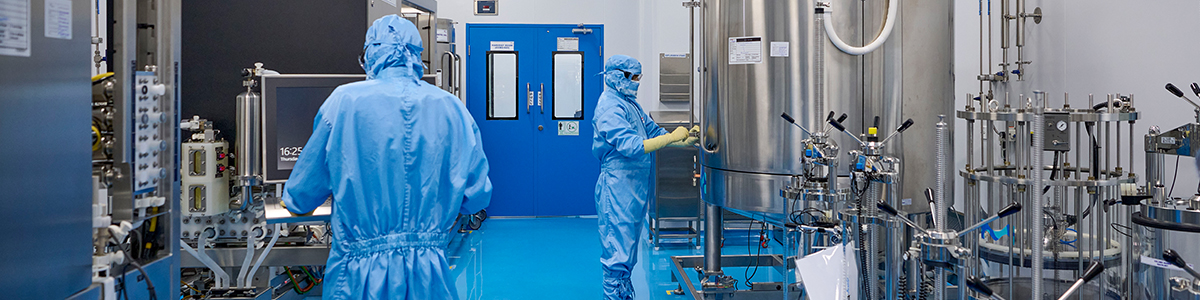

Transitioning biologics from laboratory development to commercial GMP manufacturing requires an integrated strategy that aligns process development, quality systems, technology transfer, validation, digital tools, and commercial operations from the outset. Scale-up risks often arise from differences in equipment geometry, mixing, mass transfer, analytical execution, and operator practices, all of which can affect product quality and reproducibility. A lifecycle-based approach builds robustness through early CQA assessment, CPP–CQA mapping, representative scale-down models, Quality by Design, and structured risk management. Effective technology transfer combines strong documentation with tacit knowledge sharing, supported by stage-gated validation, continued process verification, and disciplined change control. Ultimately, integrated GMP manufacturing strategies reduce scale-up risk, improve regulatory readiness, accelerate launch timelines, and support reliable commercial production of high-quality biologics.
Scale-up failures in biologics manufacturing rarely occur due to poor technical understanding—they happen because the transition from controlled laboratory conditions to commercial manufacturing reality is inadequately planned. The pharmaceutical industry has learned that moving from 2L to 2,000L bioreactor volumes involves far more than proportional scaling of parameters. Differences in equipment geometry, mixing, process timing, analytical methods, and operator practices may impact product quality and reproducibility.
Integrated manufacturing design addresses these challenges by connecting process development, technology transfer, validation, and quality oversight into a unified lifecycle approach. This begins with establishing cross-functional teams from project initiation, creating shared data systems that enable real-time collaboration, and implementing stage-gate reviews that evaluate manufacturing readiness at each development milestone. This methodology aligns with ICH Q8, Q9, and Q10 principles, emphasizing comprehensive product and process understanding, systematic risk management, and quality systems supporting the complete product lifecycle.
Commercial success requires understanding that biologics manufacturing differs fundamentally from small molecule production. Living cells respond dynamically to environmental changes, making process robustness dependent on deep biological understanding integrated with rigorous engineering parameter control—the two are inseparable in commercial bioprocessing.
This biological complexity becomes amplified during scale-up, where scale-dependent variability demands precise parameter control approaches. Process parameters that are easily maintained within acceptable ranges at laboratory scale may be subject to greater variability or dynamics at commercial volumes, necessitating revised control strategies and broader design space validation. Successful programs implement scale-down models representing commercial conditions, conduct engineering studies on changes in the volumetric mass transfer coefficient (kLa) arising from altered power-per-unit volume (P/V), agitation dynamics, and aeration strategies at scale, and design control strategies compensating for increased mixing times and concentration gradients. All control strategies—including dissolved oxygen management, pH control, temperature, and nutrient feeding profiles—are defined and characterized early in development rather than retrofitted during scale-up.
Early Scalability Integration
Effective scale-up programs embed manufacturing considerations from initial process development. This involves assessing critical quality attributes (CQAs) during cell line development through risk-based product understanding, prior knowledge, and clinical relevance evaluation aligned with ICH Q8 (R2); design of experiments (DoE) is subsequently applied during process characterization to establish CPP–CQA relationships and generating design space data accommodating scale-related variation.
Laboratory and pilot studies must predict commercial manufacturing performance, not merely demonstrate feasibility. This requires evaluating cell culture media for scalability, selecting bioreactor conditions that translate across scales, designing purification strategies compatible with commercial equipment, and developing robust analytical methods for seamless technology transfer.
| Development Phase | Scalability Considerations | Manufacturing Readiness Integration |
| Cell Line Development | Genetic stability, productivity consistency | Evaluate clones using commercial-scale selection criteria and assess productivity under manufacturing stress conditions |
| Process Development | Design space establishment, critical process parameter (CPP) mapping | Conduct scale-down studies and validate parameter ranges using commercial-representative equipment |
| Analytical Development | Method robustness, transfer readiness | Develop methods using equipment available at manufacturing sites and validate under expected analytical load |
| Process Characterization | Variability assessment, control strategy definition | Test process limits and establish control parameters based on commercial manufacturing constraints |
Risk Management Integration
Embedding quality risk management throughout development involves conducting systematic assessments using tools like Failure Mode and Effects Analysis (FMEA) to address process variability. This includes implementing contamination risk assessments through environmental monitoring studies, evaluating equipment compatibility through comprehensive engineering assessments, validating analytical method robustness through rigorous method validation studies, and assessing supply chain stability through vendor qualification programs. Continuous monitoring capabilities are designed into commercial processes from the outset by implementing Process Analytical Technology (PAT) systems and establishing trend analysis protocols that provide early warning of process deviations.
Technology transfer represents the critical bridge between development achievement and commercial execution. Effective transfer extends far beyond documentation exchange, requiring comprehensive knowledge transfer through direct interaction between development and manufacturing teams, joint training sessions, and supervised production runs that transfer both explicit procedures and tacit understanding.
Robust packages include systematic documentation of process descriptions with scientific rationale, justified operating ranges, control strategies designed to mitigate identified risks, complete deviation histories, site-specific validation protocols, and formal comparability plans meeting FDA and EMA guidance requirements.
Essential documentation includes process flow diagrams with troubleshooting guidance, raw material specifications with vendor data, equipment requirements with calibration procedures, analytical methods with validation packages, environmental monitoring strategies, and personnel training requirements with competency assessments.
Much of this institutional knowledge resists standard documentation entirely. Organizations close this gap with structured programs: joint development-manufacturing workshops, mentorship pairing experienced staff with receiving personnel, documented troubleshooting scenarios built as decision trees, and clear communication channels for technical support during initial production campaigns.
Lifecycle validation implementation recognizes that process validation in modern biologics manufacturing extends far beyond traditional three-batch qualification protocols. Validation becomes a continuous lifecycle activity by establishing validation master plans during development, conducting ongoing process performance qualification, and maintaining commercial process verification programs.
Each validation stage requires specific execution strategies:
Stage 1 – Process Design: Consolidate development knowledge and establish control strategies ensuring consistent quality
Stage 2 – Process Qualification: Execute engineering runs and demonstrate process consistency through statistical analysis
Stage 3 – Continued Process Verification: Implement statistical process control and periodic reviews with strategy updates
Achieving commercial operational discipline requires standards exceeding clinical manufacturing. This involves developing comprehensive training programs for manufacturing personnel, establishing preventive maintenance programs for all equipment, creating deviation investigation and CAPA systems, implementing supplier qualification and management programs, and establishing change control systems that evaluate impact on product quality.
Building controlled flexibility anticipates change management requirements by establishing change control procedures that evaluate impact on product quality, creating modular process designs that accommodate improvements, implementing risk assessment protocols for process changes, and maintaining regulatory communication strategies for significant modifications.
Seamless cross-functional coordination among development scientists, manufacturing teams, analytical experts, quality assurance, regulatory affairs, and supply chain stakeholders is achieved by creating integrated project teams with clear roles and responsibilities, implementing shared data management systems, establishing regular cross-functional meetings, and developing unified project plans with synchronized timelines.
Digital Integration Tools
Digital integration enables transparent data flow and real-time coordination through deployment of integrated Laboratory Information Management Systems (LIMS), implementation of Manufacturing Execution Systems (MES) with real-time data capture, establishment of electronic batch records with automatic deviation flagging, creation of collaborative project management platforms accessible to all stakeholders, and development of risk assessment tools with automated escalation procedures.
Key capabilities include common data standards with automated transfer protocols, PAT systems with automated alerts, electronic records with real-time review, secure collaborative platforms with audit trails, and risk tracking with automated escalation.
Risk Mitigation Strategies
Common scale-up risks including process drift, insufficient comparability data, incomplete analytical method transfer, equipment compatibility issues, and inadequate documentation are mitigated through stage-gated approval processes with clear go/no-go criteria, formal transfer checklists with verification requirements, engineering runs with predefined acceptance criteria, early quality assurance involvement in development planning, and comprehensive comparability study protocols.
Process alignment maintenance ensures commercial processes remain consistent with development intent through continuous process verification programs, regular cross-functional risk reviews, process performance trending systems, and change control procedures that evaluate impact on process comparability.
Successful biologics scale-up requires the early integration of process development, quality systems, technology transfer, validation, and commercial manufacturing operations. As processes move from laboratory to GMP production, differences in equipment, mixing, control dynamics, analytical execution, and operator practices can affect product quality and reproducibility. A lifecycle-based integration strategy helps anticipate these risks and build robustness from the outset. By defining CPP–CQA relationships, using representative scale-down models, and applying quality risk management, organizations can design processes that are scientifically sound and commercially executable. Comprehensive technology transfer, including documentation and tacit knowledge sharing, ensures that development intent is preserved during manufacturing transition. Stage-gated validation and continued process verification support sustained process control throughout the product lifecycle. Digital tools and integrated operating models further improve data visibility, cross-functional alignment, and decision-making. With disciplined change control, CAPA systems, supplier management, and ongoing monitoring, commercial manufacturing can remain controlled, compliant, and adaptable. Ultimately, GMP manufacturing integration enables reliable, reproducible scale-up and strengthens readiness for successful commercial launch.
Ready to discuss your biologics scale-up program?
Contact our Biologics Manufacturing team to explore integrated solutions from California discovery to Bangalore commercial production.
