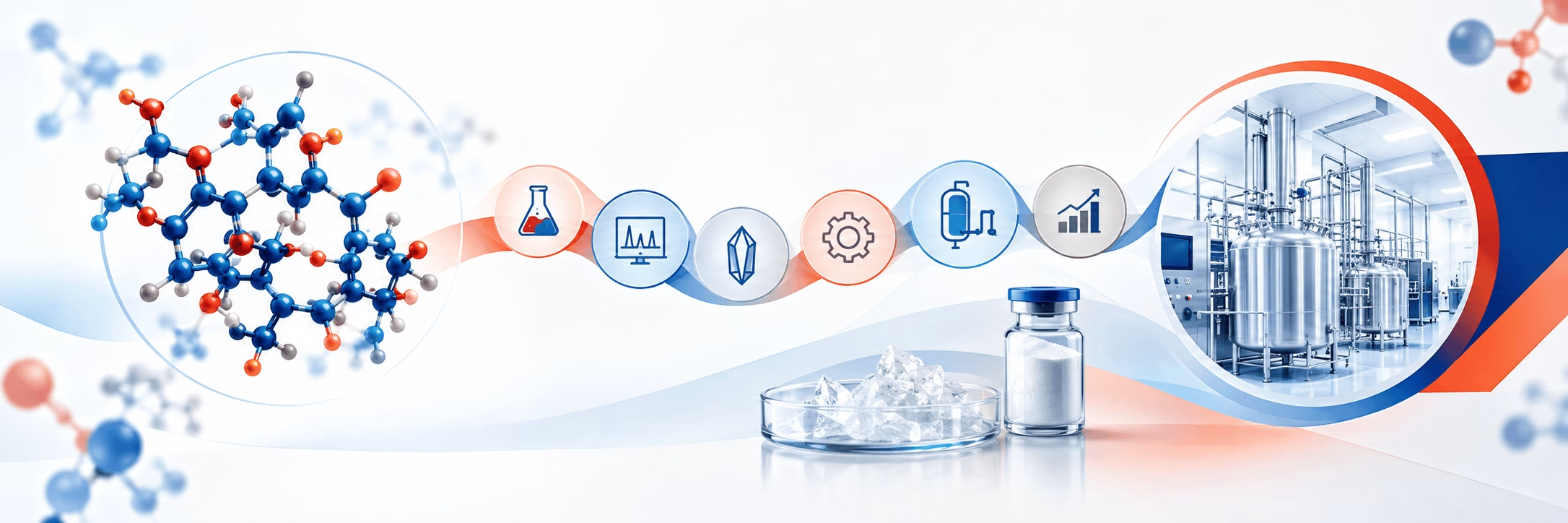

Next-generation therapeutics are increasingly characterized by molecular complexity, high potency, demanding stereochemistry, challenging impurity profiles, and difficult solid-state behavior. These attributes can introduce significant development and scale-up challenges that extend beyond synthetic feasibility. This whitepaper explores how route design, process engineering, analytical science, crystallization development, and enabling technologies help address these challenges and transform complex molecules into scalable, reproducible, and commercially viable drug substances.
Today’s therapeutic innovation is increasingly driven by molecular sophistication. Advances in targeted protein degradation, precision oncology, and rational drug design have expanded the boundaries of druggable chemical space, but they have also introduced development challenges that conventional process-development models were not built to address.
The transition from a milligram-scale molecule to a kilogram-scale, quality-assured API is not a linear amplification of laboratory chemistry. It is a scientific translation problem. Molecular complexity interacts with process conditions, engineering constraints, and regulatory expectations in ways that must be understood before scale-up begins.
For next-generation therapeutics, chemical development is where that understanding is built and where the gap between therapeutic promise and manufacturing reality is either closed or exposed.
Many next-generation APIs feature molecular architectures that differ substantially from those of traditional small molecules. Increased molecular weight, greater conformational flexibility, higher functionality, and convergent synthetic strategies can introduce development challenges that extend well beyond synthetic feasibility.
These molecules often require the assembly of multiple advanced intermediates, each with its own impurity profile, stability considerations, and process risks. Impurities introduced in one synthetic branch may propagate through subsequent transformations and remain undetected until advanced stages of development, where their structural similarity to the desired molecule can complicate purification and analytical characterization.
Molecular architecture can also influence critical physicochemical properties including solubility, crystallinity, hygroscopicity, and solid-state stability. Small changes in structure may significantly alter isolation behavior, impurity purge efficiency, and manufacturability at scale.
Consequently, successful chemical development requires integration of route design, impurity fate-and-purge analysis, analytical characterization, and solid-state understanding from the earliest stages of process development. Managing complexity upstream helps reduce downstream purification burden, improve process robustness, and support more predictable scale-up.
Many next-generation APIs combine high potency with chemically sensitive functional groups, creating a unique set of development challenges that span process chemistry, containment, analytical science, and manufacturing.
Highly potent compounds require process designs that balance product quality, operator safety, and manufacturability. Solvent selection, isolation techniques, drying strategies, particle attributes, and material handling procedures must be evaluated not only for their impact on product quality but also for their suitability under contained manufacturing conditions.
The presence of reactive or chemically labile functional groups introduces additional complexity. Such groups may undergo hydrolysis, oxidation, cyclization, dimerization, or other unintended transformations during synthesis, purification, storage, or scale-up. These pathways can generate process-related impurities that are often structurally similar to the target molecule, making them difficult to monitor, characterize, and control.
Chemical development therefore focuses on establishing process conditions that preserve molecular integrity while maintaining rigorous impurity control throughout the manufacturing route. Success depends on understanding how process parameters influence stability, reactivity, and product quality across the entire development lifecycle.
Many next-generation APIs derive their activity from precisely defined three-dimensional structures. While traditional chiral molecules already present development challenges, modern therapeutics increasingly incorporate multiple stereocenters, conformationally restricted architectures, and atropisomeric elements where biological activity depends on controlled molecular orientation.
Unlike classical point chirality established during a single reaction step, atropisomeric stability can be affected throughout synthesis, purification, drying, and storage. Elevated temperatures, prolonged processing times, solvent selection, and isolation conditions may reduce rotational barriers, leading to partial stereochemical equilibration. The resulting impurities are often structurally similar to the desired molecule and difficult to remove through conventional purification strategies.
Chemical development therefore extends beyond stereochemical generation to include stereochemical preservation. Route design, reaction conditions, isolation strategies, crystallization pathways, and storage conditions must all be evaluated for their potential impact on stereochemical integrity.
Many process failures emerge during scale-up, not because chemistry changes, but because the physical environment changes. Heat transfer, mixing behavior, mass transfer, and reaction kinetics are fundamentally different in manufacturing equipment than in laboratory glassware. For next-generation molecules, where desired reactions, degradation pathways, and stereochemical transformations may occur on similar timescales, these differences can significantly affect process performance.
Localized temperature excursions can alter selectivity or promote stereochemical erosion. Concentration gradients may generate impurity pathways not observed during laboratory development. Multiphase systems can behave differently as reactor geometry and agitation conditions change.
Successful scale-up therefore requires mechanistic understanding rather than empirical replication. Reaction calorimetry characterizes thermal risk. Kinetic studies establish reaction sensitivity. Design of Experiments (DoE) identifies interactions between critical variables. Scale-down models reproduce manufacturing conditions in the laboratory. Together, these approaches convert process knowledge into predictable operating windows capable of supporting robust manufacture.
For many next-generation therapeutics, manufacturability is ultimately determined during crystallization.
Complex molecules frequently exhibit challenging solid-state behavior, including polymorphism, poor crystal-packing efficiency, solvent inclusion, broad particle-size distributions, and liquid-liquid phase separation during isolation. Oiling out is one such challenge. Instead of forming crystals, a supersaturated solution separates into a liquid phase that can trap impurities and compromise product quality. Similarly, uncontrolled polymorphic transformations may affect stability, processability, and downstream performance.
Particle attributes create additional challenges. Crystal morphology influences filtration efficiency, solvent removal, drying behavior, and material handling. Poorly controlled crystallization can therefore affect both product quality and manufacturing throughput.
Crystallization development has evolved from a purification step into a scientific discipline focused on controlling supersaturation, nucleation, crystal growth, and solid-state form. For many complex APIs, this understanding becomes a prerequisite for successful commercialization.
Increasing molecular complexity is driving adoption of enabling technologies that address specific development bottlenecks.
Flow chemistry improves heat and mass transfer, providing tighter control for highly exothermic reactions, fast kinetics, hazardous intermediates, and cryogenic processes.
Biocatalysis provides highly selective transformations that can simplify access to complex stereochemical architectures, reducing impurity burdens and minimizing downstream purification requirements.
Process Analytical Technology (PAT) provides real-time visibility into reaction progress, phase transitions, and crystallization behavior, enabling more informed process control.
These technologies do not replace process understanding. Rather, they expand the range of chemical challenges that can be addressed safely and efficiently at scale.
Developing next-generation therapeutics requires the integration of process chemistry, analytical sciences, solid-state characterization, process safety, engineering, and scale-up expertise.
Aragen’s drug substance development platform brings these capabilities together within a connected development model spanning route design, process optimization, crystallization science, advanced analytical characterization, HPAPI development, flow chemistry, biocatalysis, and technology transfer. This integrated approach enables deeper process understanding, reduced development risk, and scalable manufacturing solutions for complex drug substances.
Next-generation therapeutics are redefining the scientific demands of drug substance development. Complex molecular architectures introduce impurity-control challenges and physicochemical complexity. High-potency and functionally sensitive molecules require precise control of molecular stability, containment, and manufacturability. Stereochemically sophisticated molecules demand preservation of molecular integrity throughout development. Crystallization increasingly determines manufacturability, while scale-up requires a deep understanding of how chemistry interacts with engineering reality.
Chemical development is where these challenges are understood, controlled, and ultimately solved. The future of therapeutic innovation depends not only on discovering complex molecules, but on manufacturing them with equal precision.
