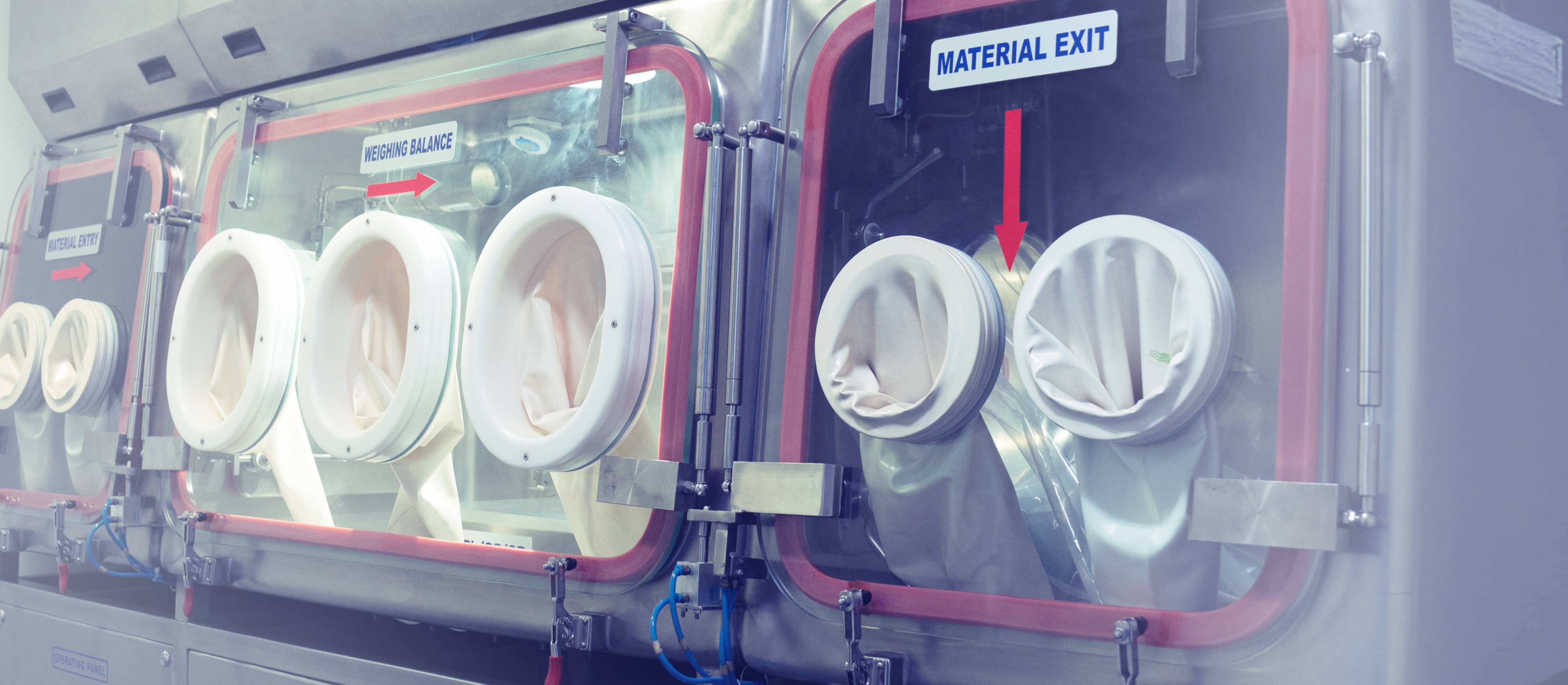

Next-generation oncology therapies increasingly rely on highly potent APIs (HPAPIs) like ADC payloads, kinase inhibitors, and novel cytotoxic agents—demanding exceptional manufacturing precision for safety and quality. While traditional containment systems remain essential, leading manufacturers are moving beyond containment through digital process control, modular facilities, and integrated R&D-to-commercial models.
This whitepaper explores the evolution of containment, emerging innovations, and what oncology developers should expect from HPAPI manufacturing partners—highlighting how Aragen Life Sciences is driving this transformation.
Modern oncology development increasingly relies on HPAPIs that exhibit therapeutic effects at microgram/nanogram doses. Key categories include:
These compounds require Occupational Exposure Limits (OELs) below 0.1 µg/ m³ to 10 µg/m³, corresponding to Occupational Exposure Band (OEB) 4–6. Manufacturing them safely and reproducibly calls for more than containment—it demands process agility, scalability, digital maturity, and regulatory robustness.
For oncology innovators, this means that their CDMO partners must operate at the intersection of chemistry, engineering, and data-driven control, where containment is integrated into a broader operational strategy.
Containment is the bedrock of HPAPI manufacturing. It refers to the rigorous combination of facility design, operational procedures, and equipment safeguards that protect personnel, maintain product purity, and comply with global regulations. Traditional containment includes:
Such measures are governed by international safety and GMP standards, ensuring that exposure remains below defined OELs. Effective containment is the foundation of HPAPI manufacturing—but it does not guarantee efficiency or scalability on its own.
The industry is now evolving towards integrated, data-rich ecosystems that embed containment within a broader digital and operational context.
“Beyond containment” means:
In essence, going beyond containment transforms manufacturing from a defensive posture to a strategic enabler of innovation.
These innovations collectively define the shift from static containment systems to dynamic, performance-driven manufacturing ecosystems.
Oncology HPAPI manufacturing faces stringent safety standards, complex containment requirements, and exacting documentation, all while scaling structurally diverse, high-potency molecules efficiently. Manufacturers must balance speed, quality, and sustainability to deliver life-saving therapies safely and reliably.
Aragen Life Sciences has engineered its HPAPI platform around this advancing scientific and regulatory landscape. Its dedicated OEB-6 compliant facilities (OEL 10 ng/m³) support safe synthesis, handling, and scale-up of potent oncology compounds. These suites incorporate closed-charging and closed-transfer technologies, barrier-isolator–based drying and filtration, high-efficiency dust-extraction systems, and advanced process analytical technologies (PAT) to enable real-time monitoring of critical quality attributes. Integrated data-integrity frameworks ensure traceability across all development and manufacturing operations.
By co-locating process development, scale-up, and GMP manufacturing, Aragen minimizes inter-site variability and reduces project transfer timelines, enabling faster transition from laboratory route exploration to clinical-grade material production. We maintain state-of-the-art equipment and adhere to globally recognized standards to ensure robust processes and consistent quality. Continuous digital monitoring, highly trained HPAPI operators, and a rigorous safety-governance model ensure alignment with US FDA, EMA, and PMDA expectations for potent-compound containment and quality control.
For oncology innovators, this capability set delivers more than containment assurance it provides a scientifically robust, operationally agile path to producing safe, scalable, and regulatory-ready HPAPIs, accelerating the journey from concept to clinic.
The industry’s conversation around HPAPIs is shifting—from “How safe is your containment?” to “How safe and smart is your manufacturing ecosystem?”
That’s the essence of beyond containment: an approach that transforms safety compliance into a platform for innovation, speed, and scalability. For oncology innovators, partnering with a CDMO aligned to this vision means more than outsourcing manufacturing—it means unlocking a pathway to clinical and commercial success, safely and confidently.
Aragen Life Sciences stands at the forefront of HPAPI development and manufacturing with advanced facilities in Hyderabad designed for highly potent molecules. Equipped with isolator technology, safety interlocks, specialized reactors, and integrated QA systems, these state-of-the-art units ensure operator safety and product integrity from early synthesis to commercial GMP production.
Robust containment measures—closed-system transfers, HEPA filtration, and real-time monitoring—guarantee global regulatory compliance while optimizing processes and safeguarding data integrity.
Driven by technical expertise and continuous innovation. By seamlessly integrating state-of-the-art technology with deep technical expertise, Aragen accelerates the development of life-saving therapies while ensuring maximum product quality and regulatory compliance.
Accelerate your breakthrough therapies—partner with Aragen to turn complex HPAPI challenges into seamless solutions.
