
The 6-month carcinogenicity study in Tg.rasH2 mice is a valid alternative to traditional 2-year bioassays in mice. Currently these mice are available from two breeder sources, viz.
Taconic, USA and CLEA, Japan.
For mice sourced from CLEA, there is a dearth of published data onpositive control urethane.
Urethane, at 1000 mg/kg bwt has been unduly toxic to mice, 1,2 but not at 500 mg/kg .
We conducted a study in Tg.rasH2 mice sourced from CLEA, Japan, to generate positive control data for urethane administered at a lower dose of 500 mg/kg bwt
on days 1, 3 and 5
Observations:
Comparison with Published Data
Made with published¹² tumor incidence in lungs and spleen, from 60 mice, sourced from Taconic and treated with urethane at 500 mg/kg bwt on days 1, 3 & 5.
The present study demonstrated comparability of carcinogenic potential of positive control urethane in Tg.rasH2 mice sourced from two breeding facilities – Taconic and CLEA
References:
Conflict of interest disclosure:
No remarkable toxicity observed at 500 mg/kg of urethane injected IP.
Tumor Incidence:
Lungs – Alveolar bronchiolar adenomas/adenocarcinomas in
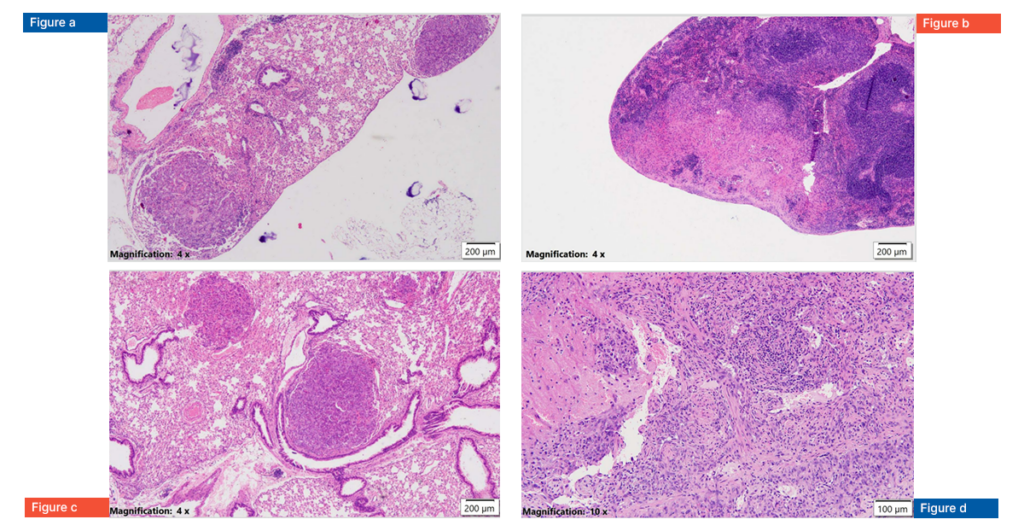
all the 20/20 mice (100% incidence) (Fig. 1 & 3);
Hemangiosarcomas co-existing in 3/20 mice
Spleen – Hemangiosarcomas in all the 20/20 mice (100% incidence) (Fig. 2 & 4)
| Source of Data | Published Studies (1, 2) | Present Study in atto |
|---|---|---|
| Incidence based on | 60 Mice | 20 Mice |
| Tumor Types | % Incidence | |
| Pulmonary adenoma/adenocarcinoma | 100 | 100 |
| Splenic hemangiosarcoma | 70 | 100 |
The comparison with published data in Taconic sourced Tg.rasH2 mice reveals that,
