
Drug substance (DS) and drug product (DP) development are often executed as sequential and independent activities, with critical decisions made in isolation. While this approach can yield APIs that meet quality specifications, it frequently introduces downstream risks—manifesting as formulation challenges, stability failures, and ultimately delays in clinical timelines.
This case study demonstrates how Aragen’s integrated DS–DP development strategy enabled a clinical-stage biotechnology company to overcome recurring formulation challenges, realign its development approach, and recover valuable time by designing drug substance attributes with drug product performance as the end goal.
A clinical-stage biotech company engaged Aragen after encountering persistent challenges during drug product development. Although the drug substance consistently met release specifications, the program faced several recurring issues:
Despite multiple formulation attempts, these challenges remained unresolved, placing clinical timelines at significant risk.
Through a thorough assessment, Aragen identified that critical drug substance decisions had been made without evaluating their downstream impact on drug product performance. This lack of DS–DP integration led to late-stage formulation issues—at a point where corrective actions are both complex and costly.
A comprehensive DS–DP evaluation revealed that upstream decisions were directly driving downstream failures:
Collectively, these issues highlighted the risks of developing drug substance without fully considering downstream formulation, manufacturability, and stability requirements.
To address these challenges, Aragen implemented a fully integrated DS–DP development model, ensuring that decisions related to solid-state properties, particle characteristics, and chemical attributes were aligned with formulation and regulatory requirements from the outset.
Key elements of the approach included:
A guiding principle was established across the program:
Every drug substance decision must clearly address its impact on drug product performance and regulatory outcomes.
This integrated framework enabled seamless alignment across chemistry, formulation, engineering, and risk management functions—creating a unified development strategy
Technical Outcomes
Program Impact
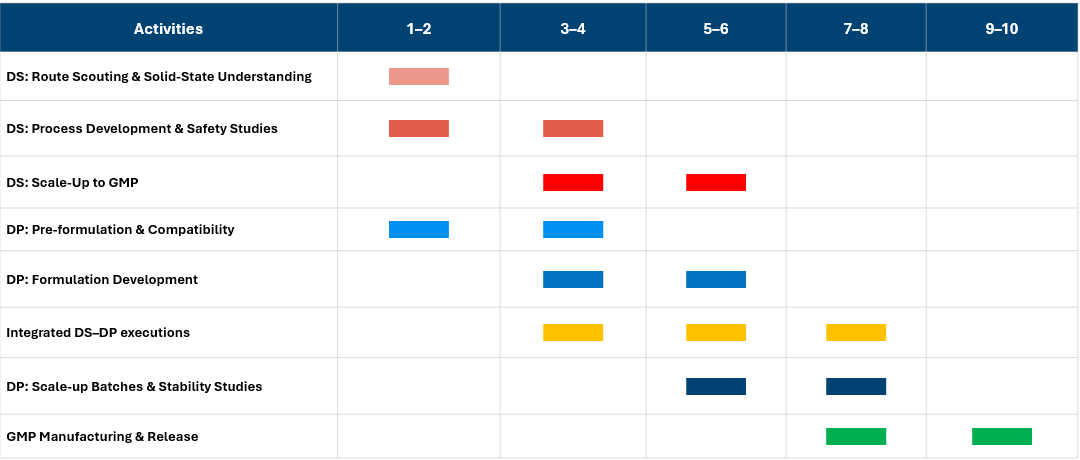
Figure 1: Integrated DS–DP development timeline illustrating parallel execution and early decision alignment to recover critical development time.
Aragen’s ability to integrate chemistry, particle science, formulation development, engineering, and manufacturing within a single ecosystem enables robust and execution-ready development strategies.
Key differentiators include:
By designing drug substance with drug product success as the ultimate objective, Aragen enables partners to de-risk development and advance clinical programs with confidence.
Connect today with Aragen to strengthen DS–DP integration early in development—improving manufacturability, stability, and regulatory confidence.
