

Developing a commercially viable API manufacturing process requires more than identifying a route that works in the laboratory. The synthetic route chosen during development must ultimately support safe, reproducible, regulatory-compliant, and economically viable manufacture at commercial scale. Decisions made during route selection, choice of reagents, process optimization, control strategies, process safety assessment, and scale-up can significantly influence development timelines, cost of goods, and long-term manufacturing success.
The most successful development programs incorporate commercial manufacturing and sustainability considerations from the earliest stages of process design. By integrating scalability, process safety, green chemistry, crystallization strategy, supply chain resilience, and process robustness into route selection and development, organizations can minimize costly late-stage process redesign, support development activities while helping address operational and environmental considerations.
This article highlights how a holistic approach to route design, process optimization, safety, crystallization development, and supply-chain planning can help transform promising laboratory chemistry into commercially successful manufacturing processes.
Route scouting is one of the most important activities in chemical development. While laboratory feasibility is essential, successful API development requires evaluation of routes through the lens of scalability, safety, raw material availability, sustainability, and commercial viability.
A route that performs well at gram scale may encounter significant challenges when scaled to pilot or commercial manufacturing. Hazardous reagents, unstable intermediates, difficult separations, low-yielding transformations, or dependence on single-source starting materials can introduce operational, supply chain, and cost risks that become increasingly significant as production volumes increase.
At Aragen, route scouting is designed to identify synthetic pathways that balance chemical feasibility with manufacturability. Multiple route options are evaluated against key development criteria, based on the following effective strategies:
Strategic Route Scouting Framework for Scalable and Cost-Effective Manufacturing:
By integrating these factors early in development, teams can establish routes that are not only synthetically effective but also suitable for long-term commercial manufacturing. Aragen focuses on effective route scouting via AI-integrated search engines.
Once a synthetic route is selected, the focus shifts to developing a robust, scalable process capable of delivering consistent product quality.
Modern pharmaceutical development is increasingly guided by Quality by Design (QbD) principles, which emphasize scientific understanding of how process variables influence product quality. Rather than relying solely on empirical optimization, development teams seek to understand the relationship between process conditions, material attributes, and critical quality attributes of the reactants /reagents in the chemical process to achieve a high-quality API.
Risk assessment-based development approaches, combined with Design of Experiments (DoE), enable systematic evaluation of process parameters and their impact on reaction performance, impurity profiles, yield, and product quality. This knowledge forms the foundation of effective control strategies and facilitates smoother scale-up and regulatory submissions. The integration of these elements within a QbD-based development framework is illustrated in Figure 1.
Aragen’s chemical development teams utilize data-driven process development approaches to establish robust operating ranges, improve reproducibility, and minimize manufacturing variability. The result is a deeper understanding of process behavior that supports successful transfer from laboratory development to commercial manufacturing.
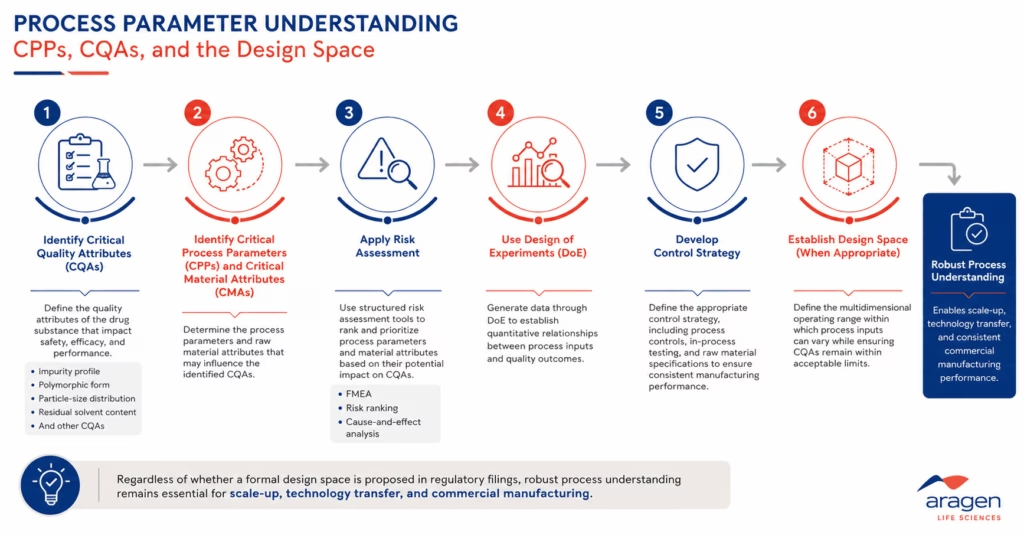
Figure 1: Quality by Design (QbD)-driven process development framework illustrating how Critical Quality Attributes (CQAs), Critical Process Parameters (CPPs), Critical Material Attributes (CMAs), risk assessment, Design of Experiments (DoE), and control strategies contribute to robust process understanding and scalable Active Pharmaceutical Ingredient (API) manufacturing.
Effective process optimization requires the systematic assessment of multiple reaction parameters, including catalysts, solvents, reagent stoichiometry, concentration, temperature, and reaction time. Conventional optimization approaches can be labor-intensive and time-consuming, especially when material availability is constrained. Aragen utilizes advanced chemical development technologies and data-driven methodologies to support process optimization, deepen process understanding, and enable robust, scalable manufacturing solutions.
Our Expertise Includes:
By combining scientific expertise, advanced analytical tools, and innovative process development approaches, Aragen delivers efficient, scalable, and robust manufacturing processes while reducing development timelines and risks.
Process safety is a critical component of successful API development and should be addressed from the earliest stages of route evaluation.
Safety-related challenges identified during laboratory development can often be mitigated through process redesign, reagent substitution, or better operating controls. By contrast, discovering thermal or operational hazards during scale-up can result in significant delays, increased costs, and manufacturing challenges.
Aragen integrates process safety evaluation throughout the development lifecycle. Key activities include:
These studies generate critical information that supports safe scale-up and helps establish appropriate operating limits for manufacturing.
Importantly, safety data is integrated directly into process development activities, ensuring that route selection, optimization, and scale-up decisions are informed by both process performance and safety considerations.
For many APIs, the isolation and crystallization process can have a profound impact on final product quality and manufacturing performance.
Solid-form characteristics influence a wide range of critical properties, including stability, purity, particle-size distribution, filtration behaviour, drying efficiency, and downstream handling. Consequently, solid-state understanding is an essential component of chemical development.
Aragen’s development teams incorporate salt screening, polymorph evaluation, and crystallization development into broader process development programs. Early identification of suitable solid forms helps minimize development risks and supports consistent product quality throughout scale-up and commercialization.
And by integrating solid-state characterization with process optimization, teams can ensure consistent manufacturing performance and reliable delivery of the target API quality profile.
A scalable process must perform reliably not only in the laboratory but also at pilot and commercial scales. Successful scale-up depends on a detailed understanding of reaction behavior, mass and heat transfer considerations, impurity control, safety parameters, and operational robustness. These factors must be evaluated and incorporated into development activities long before GMP manufacturing begins.
Aragen’s chemical development capabilities include laboratory, kilo-lab, and pilot-scale process development, enabling progressive scale-up while maintaining process understanding and control. Development teams work to generate the process knowledge, documentation, analytical support, and control strategies required for efficient technology transfer.
By addressing scale-up considerations during development, Aragen supports process development, technology transfer, and commercial manufacturing activities.
The successful commercialization of a new chemical entity requires more than strong chemistry. It requires a development partner capable of integrating route design, process optimization, safety assessment, crystallization development, scale-up, and technology transfer into a cohesive development strategy.
Aragen’s chemical development organization brings together deep expertise in API process development with advanced technology platforms and scale-up capabilities. From route scouting through commercial readiness, multidisciplinary teams focus on developing manufacturing processes that are scientifically robust, operationally practical, and commercially sustainable.
Key strengths include:
By combining scientific rigor with a strong focus on manufacturability, Aragen helps clients transform new chemical entities into scalable, commercially viable APIs ready for successful manufacturing and market supply.
Connect with Aragen’s Chemical Development team to explore scalable route design, process optimization, safety assessment, and commercialization strategies for your next-generation small-molecule API.
