

Scaling an API process from laboratory to commercial manufacture is rarely straightforward, and process design decisions made early carry consequences that compound at every subsequent stage. While batch chemistry remains the industry default, it carries structural limits that become increasingly exposed as reaction volumes grow, hazard profiles tighten, and timelines shorten. Continuous flow chemistry addresses these limits by performing synthesis in a tube or pipe, where reagents travel through a controlled reaction zone with precise residence times, superior heat exchange, and real-time process control—conditions that a large batch vessel cannot replicate at scale. CDMOs with integrated process engineering and safety infrastructure are best positioned to evaluate this decision objectively and execute it without program risk. This article details the exact conditions under which the switch from batch to flow is warranted, and the scientific and commercial case for making it.
Batch chemistry’s limitations are structural, not incidental. As vessel volume increases, the surface area-to-volume ratio decreases, thereby compromising heat transfer, promoting hotspot formation, and generating inconsistent mixing. A reaction that performs cleanly at 5L can produce a different impurity profile, different selectivity, and a different thermal footprint at 500L, not because the chemistry has changed, but because the physics of the vessel have. Every scale-up step in batch requires re-optimization, recharacterization, and often additional validation work before a program can advance.
Compounding this, batch reactors operate within narrow process windows—typically below 200°C and 30 bar, placing high-pressure hydrogenations, cryogenic organolithium chemistries, and superheated solvent reactions beyond practical reach. Reactions involving extremely exothermic kinetics and unstable intermediates, auto-catalytic behaviour, or highly toxic reagents become structurally unmanageable at large vessel volumes, where thermal runaway risk scales directly with the quantity of material present throughout the reaction.
Space time yield (STY): Space–time yield (STY; kg m−3 s−1) represents the mass of a product formed per volume of the reactor and time. For batch reactors, STY is less than 1, while for plug-flow reactors (PFR), it is less than 500. Which means, for the same reactor volume, productivity is close to 500x in flow compared to batch.
The decision to switch is not based on general preference for newer technology. It is based on whether the specific reaction profile makes batch chemistry scientifically or operationally untenable at scale. Five conditions consistently define when a switch to continuous flow is the more defensible CMC choice:
| Condition | Why Batch Is Inadequate | Why Flow Resolves It |
| Highly exothermic reactions | Thermal gradients across large reactor volumes create runaway risk and variable selectivity | Microreactors offer exceptionally fast heat and mass transfer due to high surface area-to-volume ratios; heat can be applied and removed efficiently, allowing precise temperature control and preventing hot spots, temperature gradients, and thermal runaways |
| Hazardous or toxic intermediates | Large-volume inventory of hazardous material throughout the reaction | Flow processes are considered intrinsically safer because of dramatically lower reactor volumes — 1 mg of an explosive azide is far less hazardous than 1 gram, whereas in batch, a hazardous intermediate is obtained and held in inventory of kilograms to tonnes |
| Photochemical and electrochemical reactions | Light penetration depth and electrode surface area do not scale with batch vessel volume | Flow reactors have superior light penetration for more efficient photon utilization in photochemical reactions, and much better electrode S/V ratio for faster electron transfer in electrochemical reactions |
| Novel process conditions | Batch condition exploration is limited by reagent/solvent boiling points and reactor pressure limiting the reaction space | Flow reactors can be easily pressurized up to 300 psi and can be heated above 200°C, far beyond boiling points of solvents, opening up new process research space and accelerating reaction rate by up to 1000x. |
| Tight impurity specifications | Inhomogeneous mixing in large batch vessels creates variable selectivity and inconsistent by-product profiles | Flow reactors enhance mass and heat transfer, resulting in rapid reaction mixing and precise control over reaction parameters, increasing overall process selectivity, efficiency, and safety |
| Multi-step sequences | Each isolated intermediate requires its own purification, workup, and stability management | Multicomponent reactions in flow further enable the rapid construction of drug-like molecules while minimising step count and environmental impact |
| Mass transfer Limited reactions | Less localized mixing in batch results in inefficient mass transfer and longer reaction time leading to impurity formations, especially chemistries where Damkohler number is > 1. | Intense, localized mixing, mass and heat transfer using static in-line mixers accelerates mass transfer, and reduces reaction times multifolds while simultaneously reducing impurity profile |
Beyond these technical triggers, not all chemical profiles perform better under flow conditions, and it is essential to evaluate whether an API will perform better with batch versus flow chemistry, as this dictates not only the process used for scale-up but also the facility and expertise needed to do it successfully. The switch to flow is a deliberate, chemistry-led program decision made at the process development stage—not a default, and not a retrofit.
Novel Process Windows
Most chemical reactions are not processed under kinetically controlled conditions, but rather under mass- or heat transfer-controlled conditions. The class ofsuch “slow” reactions are quite substantial, since it includes many major chemical transformations such as nucleophilic substitutions. Applying process intensification in microreactors, reaction times can be further reduced from hours to seconds by exploiting much faster kinetics, which could be termed “intensified intrinsic kinetics”.
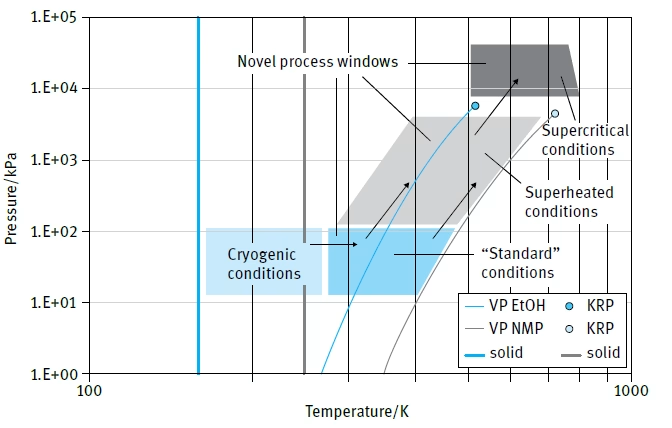
Figure 1: Novel process windows shift the reactions toward high temperature/pressure realization, while increasing the reaction rate [adapted from Hessel, V. (2011) Adding a Chemical and Process Intensification Field to Flow Chemistry Transport-Engineered Through Microreactors].
Quality and Process Control
In batch, quality is confirmed at the end of a completed vessel—a model that is reactive by definition. Flow chemistry inverts this by offering precise control over temperature, pressure, and residence time, enhancing product consistency and suppressing side reactions that are unavoidable in batch mixing at scale. When a process deviation occurs, in-line Process Analytical Technology (PAT) detects it in near-real time, enabling diversion of out-of-specification material rather than rejection of an entire batch. ICH Q13, implemented across the FDA, EMA, and PMDA, endorses this quality-by-design control model, and as of 2026, the FDA has approved 17 pharmaceuticals that utilise continuous manufacturing in their production—a number that has grown steadily since the first approved drug manufactured via continuous manufacturing.
Safety
The safety case for flow is mechanical, not procedural. Flow chemistry allows only a small amount of hazardous intermediate to be formed at any instant, making a flow reaction intrinsically safer than its batch counterpart due to dramatically lower reactor volumes. Entire reaction classes that are structurally impractical in batch at scale—Curtius rearrangements, nitrations, diazomethane chemistry, organolithium reactions—become viable manufacturing options in flow. Smaller reactant volumes minimize exposure to toxic substrates, eliminate the need to store hazardous reagents in bulk inventory, and remove the risk associated with manual sampling at large scale.
Scale-Up Speed and Simplicity
Batch scale-up is sequential and geometry-dependent, each step from laboratory to kilo lab to pilot plant requires re-optimization of mixing, heat transfer, and reagent gradients. Flow eliminates this problem at its source. Scaling up is achieved by running a continuous flow reactor for longer or numbering up reactors in parallel, keeping reaction conditions, kinetics, and selectivity identical across all scales. Typical batch lead times run 6–12 months depending on complexity; a continuous process can deliver first API quantities in weeks. For CMC teams managing IND-to-NDA timelines, this compression is a commercially material program advantage.
Sustainability and Manufacturing Footprint
The environmental profile of an API manufacturing process is no longer secondary to its commercial profile. A comparative assessment of batch and flow syntheses across seven industrially relevant APIs (tamoxifen, ibuprofen, and artesunate) found that continuous-flow processes are significantly more sustainable across eleven environmental impact categories, with improvements in energy efficiency, water consumption, waste reduction, and up to a 97% reduction in energy consumption in documented cases. Flow chemistry further reduces plant footprint, lowers in-process inventory, and minimizes operational labour besides structural improvements for programs where process mass intensity (PMI) and E-factor are formally tracked.
Regulatory Standing
Regulatory uncertainty around continuous manufacturing is fully resolved. The FDA adopted ICH Q13 in March 2023, followed by the EMA in July 2023. The FDA’s Advanced Manufacturing Technologies (AMT) Designation Program, finalised in January 2025, now provides a formal pathway to recognize and incentivise continuous manufacturing adoption. Commercial precedent is firmly established: the FDA has approved 17 pharmaceuticals utilizing continuous manufacturing, up from the first approval of Orkambi in 2015 and Prezista® became the first supplemental NDA approval for converting an existing batch process to continuous manufacturing. Continuous manufacturing is no longer a regulatory frontier—it is a supported, well-precedented, and actively incentivised CMC pathway.
Ready to evaluate whether your API process is a candidate for continuous flow chemistry? Contact Aragen’s Process Chemistry team.
