
Allometric Scaling for Peptides: Myths, Pitfalls, and Predictive Strategies
Peptide therapeutics continue to gain momentum across metabolic disorders, oncology, and other high-value therapeutic areas. However, for sponsors advancing peptide candidates toward the clinic, one question remains critical: Can preclinical pharmacokinetic (PK) data reliably predict human exposure?
Allometric scaling has long been used to support human PK predictions and first-in-human dose selection. Yet, many peptide programs reveal the limitations of relying on scaling alone. The challenge is not simply extrapolating data across species—it is understanding the biological mechanisms that drive peptide disposition and determining whether those mechanisms translate to humans.
Myth #1: Allometric Scaling Is Sufficient for Human PK Prediction
Traditional allometric scaling uses body weight-based relationships across species to predict parameters such as clearance and volume of distribution. While effective for many small molecules, peptides frequently defy these assumptions.
Unlike conventional compounds, peptides are often cleared through multiple pathways, including proteolytic degradation, renal filtration, receptor-mediated uptake, and target-mediated drug disposition (TMDD). These mechanisms do not necessarily scale proportionally with body weight, increasing the risk of inaccurate human PK predictions.
For sponsors, this means that a seemingly straightforward scaling exercise may overlook critical biological factors that ultimately influence clinical exposure.
Common Pitfalls That Can Derail Translation
Several factors can reduce the predictive value of conventional allometric approaches:
Species-Specific Metabolism
Protease expression and activity can vary significantly across rodents, non-human primates, and humans. As a result, peptide stability and clearance observed in one species may not accurately reflect human behavior.
Differences in Absorption and Distribution
For modified peptides—such as lipidated, PEGylated, or albumin-binding molecules—absorption, bioavailability, and tissue distribution can differ considerably across species, complicating translation.
Target-Mediated Drug Disposition
For peptides targeting highly expressed receptors, target engagement itself may influence clearance. The resulting nonlinear PK behavior can significantly impact exposure predictions and first-in-human dose selection.
These challenges highlight a broader reality for sponsors: the success of peptide translation depends less on scaling equations and more on understanding the mechanisms behind the data. Figure 1 illustrates how integrating allometric scaling with mechanistic DMPK studies and translational modeling can improve human PK prediction and support more confident first-in-human dose selection.
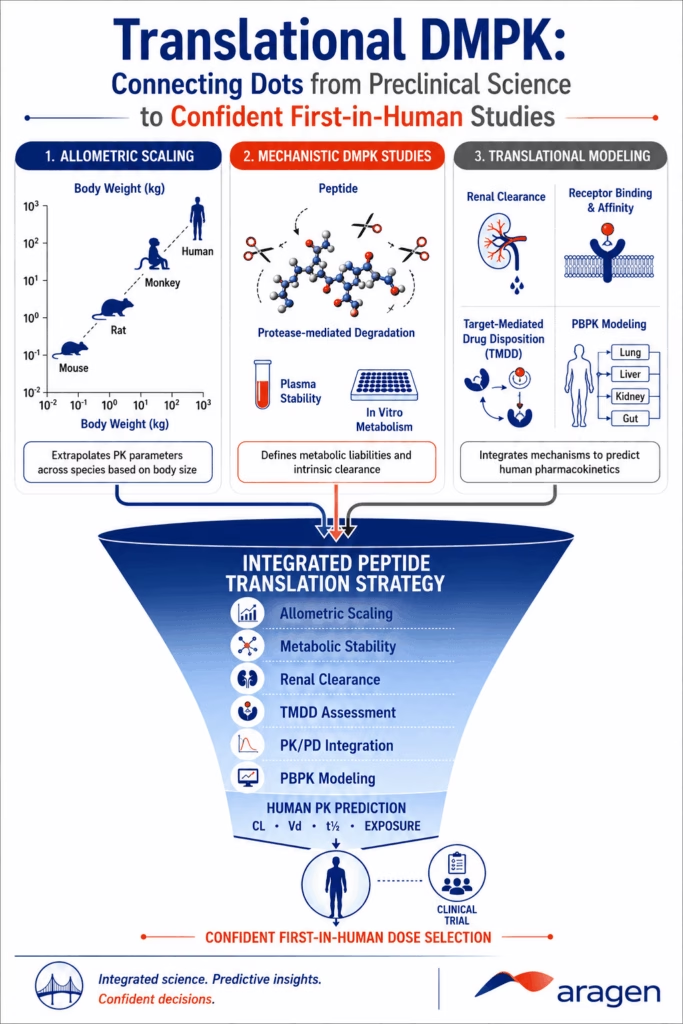
Figure 1: Translational DMPK framework for peptide development integrating allometric scaling, mechanistic DMPK investigations, and PBPK modeling to improve human PK prediction and first-in-human dose selection.
Moving Beyond Scaling: A Translational DMPK Strategy
The most successful peptide programs combine allometric scaling with mechanistic DMPK investigations that answer key translational questions:
- Will the peptide remain stable in humans?
- In vitro metabolic stability studies reveal species-specific degradation patterns and help identify the most predictive preclinical models.
- What drives clearance?
- Renal clearance studies and TMDD assessments clarify whether elimination is governed by filtration, target interactions, or multiple pathways.
- Will exposure support efficacy?
- Plasma and tissue binding studies, coupled with PK/PD analyses, help establish exposure-response relationships and therapeutic windows.
- How predictive are current models?
- Physiologically based pharmacokinetic (PBPK) modeling integrates biological and drug-specific data to improve human PK predictions and support dose selection.
By answering these questions early, sponsors can make more informed decisions on candidate selection, optimization strategies, and clinical planning.
The Aragen Advantage: Enabling Smarter Translation
From a CRDMO perspective, the goal is not simply to generate DMPK data—it is to translate data into actionable development decisions.
At Aragen, peptide discovery is integrated with DMPK, bioanalytical, and translational sciences capabilities to help sponsors build a more complete understanding of peptide disposition. By combining peptide optimization with in vitro and in vivo DMPK assessments, bioanalysis, and modeling approaches, teams can identify translational risks earlier and strengthen confidence in human PK predictions.
This integrated strategy enables sponsors to move beyond empirical scaling assumptions and toward mechanism-informed decision-making throughout discovery and development.
Conclusion
For peptide therapeutics, the key question is not whether allometric scaling works—it is whether scaling is supported by the right translational evidence. Integrating allometric approaches with DMPK, bioanalysis, and modeling provides the mechanistic insight needed to improve human PK prediction, reduce development risk, and make more confident candidate advancement decisions.
Reviewed by

Vishwottam Kandiere
M. Pharm, PhD, Vice President – DMPK
Aragen Life Sciences
Looking to strengthen the translational success of your peptide programs? Connect with Aragen to explore integrated peptide discovery and DMPK strategies that support more confident clinical decision-making.
