
 Back to News
India’s race for the CDMO crown
September 08, 2026
For years, China+1 has been the big story in India’s CDMO opportunity. Now, it is no longer enough. The shift away from China is well underway as global pharma seeks to lessen their exposure to geopolitics, and this clearly benefitted India.
A BCG-IPSO’s report titled, Unleashing the Tiger: Indian CRDMO Sector 2025 estimates that “India’s CRDMO industry could grow from around $3–3.5 billion in 2024 to $22–25 billion by 2035.”
The same report also identifies $10-15 billion of potential value from global supply-chain realignment, along with opportunities in new modalities and India’s emerging innovation ecosystem. Its customer research, a survey of more than 200 CRDMO customers, estimates that around $5 billion of demand could move to India, while another $9-10 billion represents unmet demand that India could potentially capture.
The opportunity is significant. But some of the business coming to India today is still risk management, not conviction. Being the alternative is not the same as being the partner of choice.
The harder question is whether India can turn this initial advantage into something more durable such as long-term relationships with global pharma, a deeper position inside development pipelines and a place among the world’s preferred CDMO destinations.
As competition intensifies, India will have to earn that position on its own merits.
Beyond China+1
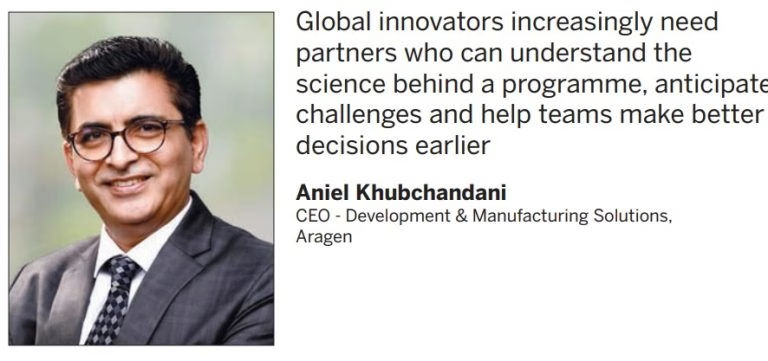
Aniel Khubchandani, CEO – Development & Manufacturing Solutions, Aragen, frames the opportunity differently. He says, “India does not need to replicate China’s CDMO model; it needs to build a differentiated proposition of its own. China has developed significant scale, infrastructure and deep manufacturing ecosystems over many years. India’s opportunity lies in combining its established strengths in chemistry, scientific talent and cost competitiveness with stronger capabilities in integrated drug development, biologics, advanced modalities and high-quality manufacturing.”
Khubchandani outlines how the role of a CDMO has evolved. “Indian CDMOs are already moving beyond a model defined primarily by cost and manufacturing scale. The next phase of the industry will be defined by how effectively CDMOs can contribute across the drug development journey, from early discovery and process development to scaleup, regulatory support and commercial manufacturing. Global innovators increasingly need partners who can understand the science behind a programme, anticipate challenges and help teams make better decisions earlier,” he points out.
However, he doesn’t present the transition as automatic and points out that it “requires deliberate capability investment, business model evolution, and willingness to own risk alongside clients – things most Indian CDMOs have historically avoided.” That is where the definition of a CDMO partnership starts to change.
What India already has
The case for India does not rest on geopolitics alone. It also has several structural strengths. Khubchandani also concurs, but distinguishes between the industry’s top layer and its average. He says, “Tier 1 Indian CDMOs operate with genuinely embedded quality systems and have clean regulatory track records. Global pharma clients conducting audits are increasingly aware of this bifurcation.”
But that bifurcation may be one of the industry’s key challenges. India does not have a capability problem, but it has a consistency problem across the ecosystem.
Cost is no longer the pitch
That also changes the way Indian CDMOs need to sell themselves. Global pharma companies no longer just want a manufacturer that can execute a defined process. Increasingly, they want a partner that can help move a molecule through development, end to end. Khubchandani captures the mindset change in a single line and states, “The firms that survive and lead will be those that have moved from execution for-hire to genuine scientific partnership.”
The talent bottleneck
Underneath the consistency problem sits a talent problem. Khubchandani’s numbers point to progress and a persistent gap sitting side by side. He says, “AI-linked skill demand in Indian CDMO grew 180 per cent in last two years — the intent and the talent pipeline are real. Yet continuous manufacturing, where Lonza and Pfizer CentreOne are genuinely ahead, remains India’s clearest technology gap in small molecules. We are catching up fast.”
Execution, not potential
China+1 gave India a strong push. It also delivered a quiet warning: diversification creates options for customers, not loyalty. India is no longer just competing with China. It is competing with every geography trying to become the next trusted outsourcing destination. The raw materials for success are already on the table.We have the scale, talent, cost competitiveness, manufacturing experience and a regulatory track record that is gradually maturing. What’s left is unglamorous but unavoidable. Do what was promised, deliver when promised and get it right, consistently. India’s CDMO opportunity was helped along by a geopolitical shift. Its future will be decided by something far more basic, whether global pharma can trust an Indian CDMO with its molecule for the next ten years. That’s the real test. And it is how India moves from being the alternative to becoming the choice.
Source – EXPRESS PHARMA
