
Bridging Material Science and Particle Science: A Roadmap from Molecular Pharmaceutics to Manufacturing Scale
The ecosystem of drug development involves multiple interconnected activities that collectively enable integrated drug substance (DS) and drug product (DP) development. Along this continuum, several scientific disciplines must work in parallel, including a critical interface between Material Science (solid-state science) and Particle Science (crystallization and particle engineering).
A silent gap often exists between what material scientists select and what particle engineers can reproducibly manufacture. The conventional handoff is frequently simplified: the material scientist says, “This is the salt or polymorph we screened and recommend,” and the particle scientist responds, “We can produce and scale it.” However, the real developability question is whether that selected form can be crystallized reproducibly, batch-to-batch, with the precise PXRD fingerprint, particle size distribution, morphology, surface properties (where applicable), and bulk behavior needed for downstream DP manufacturing.
This distinction between material (solid form) identity and particle attributes is often where development programs either accelerate or encounter delays.
The Material Science Question: What Solid Form Should We Make?
Material science begins with a fundamental decision: free base, salt, or co-crystal?
This is not merely a solubility-driven formulation question. It is a developability decision grounded in thermodynamics, stability, manufacturability, and processability constraints.
The solid-form selection process must evaluate a constellation of factors:
- Lattice energy and crystal packing geometry: Which form occupies the most favorable thermodynamic minimum?
- Aqueous and biorelevant solubility: What equilibrium and kinetic dissolution behavior is required?
- Melting behavior and hygroscopicity: How does the form respond to thermal stress and moisture exposure?
- Polymorphic landscape: How many solid forms exist, and which are stable under manufacturing and storage conditions?
- Hydrate and solvate propensity: Is the form likely to absorb solvent or crystallize as a hydrate?
- Solid-state transformation risk: Does the form exhibit a tendency to convert into alternate forms under stress?
- Crystallization feasibility: Can the form be isolated and scaled reproducibly?
- Downstream processing behavior: Can it withstand drying, milling, granulation, or compression without undergoing transformation?
Once a candidate form has been selected, material science must evaluate its stability against process-induced phase transformations (PIPT). This critical assessment is often underestimated. A polymorph may be thermodynamically stable under equilibrium conditions, yet mechanical stress, moisture exposure, thermal cycling, or drying operations can induce localized amorphization, defect formation, or polymorphic conversion.
Early stress-testing studies, including high-shear milling, moisture sorption cycling, compression, and thermal excursions, should confirm that the selected form remains stable throughout the intended manufacturing process.
Material science therefore establishes:
- The target solid form (polymorph, salt, co-crystal, hydrate, or solvate)
- Thermodynamic stability and metastability relationships
- Critical processability boundaries (thermal limits, moisture sensitivity, and mechanical stress tolerance)
- Early indicators of potential process-induced transformations
The Particle Science Question: How Do We Scale and Manufacture It Reproducibly?
Once material science identifies the desired solid form, particle science must answer a different but equally important question:
“How can we crystallize this form consistently, batch after batch, while delivering the particle attributes required for robust drug product manufacturing?”
This challenge lies at the heart of the Material Science to Particle Science continuum.
Nucleation and Crystal Growth Kinetics
Supersaturation (both temperature-dependent and solvent-mediated) drives both nucleation and crystal growth. Temperature profiles, solvent selection, antisolvent addition rates, seeding strategies, mixing dynamics, and residence time can all influence whether crystals form as the desired polymorph or as unintended solid forms. Careful process design is required to ensure controlled nucleation and predictable crystal growth.
PAT-Enabled Real-Time Control
Modern crystallization processes increasingly rely on Process Analytical Technology (PAT) tools such as Focused Beam Reflectance Measurement (FBRM), Raman spectroscopy, ATR-FTIR, in situ concentration measurements, pH monitoring and temperature monitoring. These tools provide real-time insights into nucleation onset, crystal growth behavior, particle-size progression, and solid-form evolution.
PAT-generated data can support feedback and model-informed process controls that adjust temperature, antisolvent addition, agitation, or residence time to maintain target crystal attributes throughout processing.
Delivering Consistent Particle Attributes
A well-designed crystallization process should consistently deliver:
- Target polymorph or solid form
- Particle size distribution (PSD), where applicable
- Crystal morphology (equant, acicular, tabular, or plate-like)
- Bulk density and flow characteristics
- Surface area and surface energy, where applicable
The critical insight is that reproducible particle/crystal micromeritics along with the rigour of the chemistry. It demands precise control over crystallization thermodynamics and kinetics. A 10% variation in temperature during cooling, a 15-minute deviation in mixing, or an antisolvent addition rate that shifts by 5%, a totally different reactor occupancy, a last minute change in agitator type, and others, can be the difference between generating Form A with a narrow PSD and inadvertently nucleating Form B or amorphous precipitate.
A Particular Risk: Micronization and Process-Induced Transformation
Particle-size reduction is often necessary to improve dissolution performance or meet drug product critical quality attributes (CQAs), including content uniformity and blend homogeneity.
However, micronization introduces mechanical energy into the system, which can trigger a series of structural changes:
Crystal → Defect-Rich Crystal → Partially Amorphous Material → Metastable Polymorph → Stable Polymorph
A successful reduction in particle size does not necessarily indicate a successful process. Mechanical stress may create crystal defects, partial amorphization, or polymorphic transitions that compromise product stability and performance.
The material may subsequently recrystallize during storage or downstream processing, potentially resulting in altered dissolution behavior, flow characteristics, compressibility, or density.
Therefore, material science must determine whether the selected form is mechanically sensitive and assess the likelihood of post-processing transformations.
Where such risks exist, particle scientists should not rely solely on micronization. Instead, crystallization and isolation parameters should be optimized to achieve the desired particle-size distribution while minimizing unwanted changes to the solid state.
When milling is unavoidable, in-line or at-line analytical techniques such as Raman or NIR spectroscopy can be used to monitor potential polymorphic conversion and control processing conditions before significant amorphization occurs.
The Integrated Development Framework
The Material Science → Particle Science continuum (Figure 1) demonstrates that manufacturing robustness depends on two interconnected decisions.
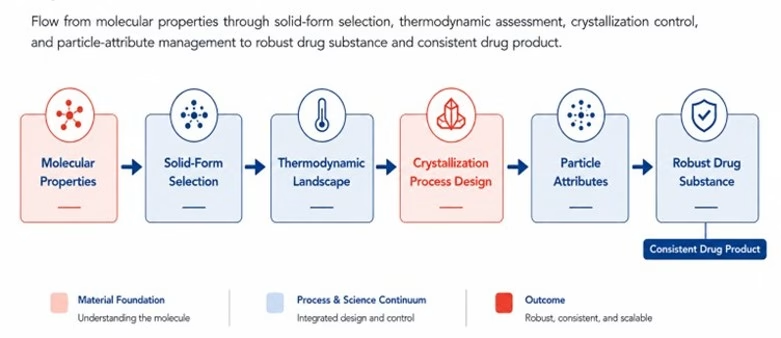
Figure 1 : The Material Science to Particle Science Continuum.
Material scientists must define:
- The optimal solid form
- Stability relationships between forms
- Processability limits
- Transformation risks
Particle scientists must design:
- Robust crystallization processes
- Scale-appropriate operating conditions
- Control strategies supported by PAT
- Consistent particle-attribute outcomes
Selecting a salt, polymorph, or co-crystal is therefore only the starting point. The true developability challenge lies in establishing a scalable crystallization process capable of reproducibly generating that form with consistent particle size distribution, morphology, and bulk behavior at manufacturing scale.
| Material-Science Attribute | What Material Science Establishes | Why Particle Science Needs It |
| Solid form (polymorph / salt/co-crystal) | Target form identity and thermodynamic rank | Defines crystallization endpoint and scale it |
| Thermodynamic stability | Stable/metastable relationship at process and storage conditions | Avoids nucleating unintended forms during crystallization |
| Solubility and kinetics | Equilibrium and kinetic dissolution curves | Guides supersaturation design and crystallization trajectory |
| Hygroscopicity | Moisture uptake vs. RH isotherm | Informs drying/processing conditions to prevent hydrate formation |
| Transformation tendency | Solid-state conversion risk under thermal, moisture, mechanical stress | Determines whether milling or processing can induce polymorphic shifts |
| Mechanical sensitivity | Susceptibility to amorphization or defect formation under shear | Governs micronization strategy and speed limits |
Why This Matters for Development Timelines
The Material Science → Particle Science framework has a direct impact on program execution.
Avoiding Rework
Early solid-form selection supported by stress testing and crystallization feasibility assessments helps prevent late-stage surprises during scale-up and commercial manufacturing.
Reproducible Supply
Consistent drug substance quality reduces variability in formulation development and downstream manufacturing operations.
Regulatory Confidence
An integrated control strategy linking crystallization parameters to drug substance critical quality attributes strengthens CMC filings and supports regulatory discussions.
Accelerated Timelines
When particle science reproducibly delivers the form specified by material science, clinical batch manufacturing becomes more predictable, reducing scale-up cycles and development delays.
The Path Forward
The competitive advantage increasingly belongs to organizations that treat material science and particle science not as sequential handoffs, but as a unified scientific discipline.
Material scientists must identify the optimal solid form and establish the physicochemical boundaries required to consistently generate and maintain that form. Particle scientists must translate those requirements into scalable crystallization processes supported by robust process understanding and PAT-enabled control strategies.
This integration transforms drug substance development from an empirical exercise into a predictive, data-driven science, enabling more robust clinical development and laying the foundation for manufacturing excellence at scale.
Looking to de-risk solid-form selection and crystallization scale-up? Partner with our integrated material and particle science experts to accelerate development with confidence.
