

Bispecific antibodies (bsAbs) are an important therapeutic modality due to their ability to simultaneously engage two distinct targets, enabling mechanisms such as T-cell redirection, co-receptor blockade, and receptor crosslinking across oncology and immunology.
The HC × scFv Fc format—an asymmetric architecture combining a conventional IgG arm with an Fc-fused scFv—poses key manufacturing challenges, including chain mispairing, increased aggregation risk from the scFv domain, and purification complexity due to co-capture of Fc-containing species requiring orthogonal polishing. Addressing these challenges early requires scalable expression, sequence-specific purification, and robust analytical characterization to ensure product integrity and reduce downstream risk.
In this study, Aragen enabled rapid expression, purification, and characterization of an HC × scFv Fc bispecific human IgG1 using a transient ExpiCHO® platform and a streamlined two-step chromatographic purification strategy.
The client required rapid generation of a high-quality HC × scFv Fc bispecific IgG1 to support early feasibility studies. The project scope demanded that the following criteria be met within a compressed timeline:
Expression Strategy
The target molecule—an HC × scFv–Fc bispecific human IgG1—was expressed transiently using the ExpiCHO® system (Thermo Fisher Scientific), an Expression constructs encoding the two asymmetric heavy chains and the cognate light chain were transfected at an optimized DNA ratio into ExpiCHO-S cells using ExpiFectamine CHO reagent. Post-transfection, cells were cultured at 32°C with addition of ExpiCHO Enhancer and Feed on Day 1 and Day 5, respectively (Max Titer protocol). The culture supernatant was harvested prior to chromatographic capture.
Harvest titer: 372 mg/L | Scale: 0.5 L
This strategy enabled rapid material generation with efficient secretion of the correctly assembled bispecific antibody.
Purification Strategy
Purification was designed around a two-step platform chromatography workflow to achieve both high recovery and high selectivity for correctly assembled bispecific product.
Purification Yield and Purity Progression
Progressive enrichment of the target bispecific antibody was confirmed by SDS-PAGE analysis of samples collected at each purification stage (Figure 1). The clarified harvest lane shows multiple protein bands corresponding to host cell proteins and other secreted species, with the product of interest (POI) detectable at the expected apparent molecular weight. Following Protein A affinity capture, the post‑Protein A lane demonstrates substantial enrichment of the POI accompanied by a marked reduction in non‑product‑related impurities.
Subsequent CH1‑XL polishing further improved product purity, yielding a predominantly homogeneous band corresponding to the POI, with no detectable residual host cell proteins or observable product‑related variants, indicating effective downstream purification and high final product purity.
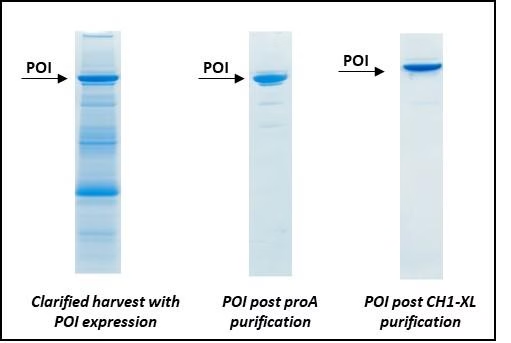
Figure 1: Purification of HC × scFv Fc bispecific antibody. Representative SDS PAGE images showing clarified harvest, post–Protein A capture, and post–CH1 XL polishing samples, illustrating progressive enrichment of the product of interest.
Structural Integrity and Size Homogeneity
The purity, structural integrity, and size homogeneity of the final bispecific antibody were evaluated using SDS-PAGE and analytical size-exclusion chromatography (SEC) (Figure 2). SDS-PAGE analysis under reducing and non-reducing conditions demonstrated bands consistent with the expected antibody polypeptide composition and intact molecular assembly, with no evidence of significant degradation or misassembly (Figure 2A). Analytical SEC profile revealed a dominant monomeric peak with negligible aggregation (Figure 2B), confirming excellent size homogeneity.
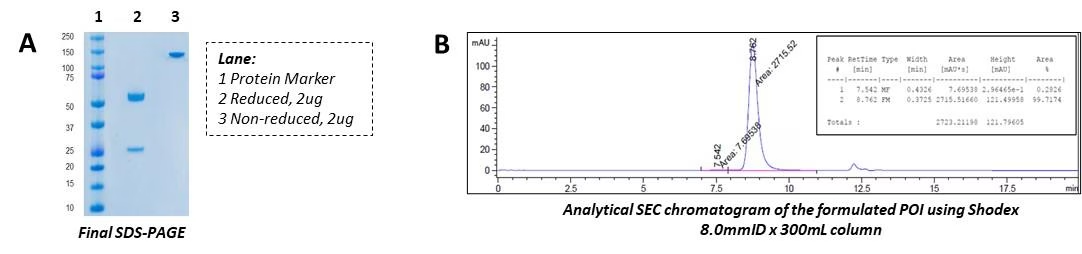
Figure 2: Analytical characterization of the purified bispecific antibody. (A) SDS‑PAGE analysis of the final purified bispecific antibody under reduced and non‑reduced conditions showing expected molecular integrity and high purity (Lane 1: protein marker; Lane 2: reduced sample, 2 µg; Lane 3: non‑reduced sample, 2 µg). (B) Analytical SEC profile of the formulated product recorded using a Shodex 8.0 mm ID × 300 mm column, demonstrating a predominantly monomeric species with minimal aggregation.
| Quality Attribute | Result | Context / Method |
|---|---|---|
| Expression Titer | 372 mg/L | Transient ExpiCHO® (0.5 L scale) |
| Final Yield | 69.3 mg | Post two-step chromatographic purification |
| Final Concentration | 1.54 mg/mL | Formulated bulk |
| Purity (SEC / SDS-PAGE) | >99% | Predominantly monomeric species |
| Endotoxin Level | <0.398 EU/mL | Suitable for further development |
Aragen successfully delivered a high-purity bispecific antibody using a scalable ExpiCHO transient expression system integrated with a robust, two-step chromatographic purification platform, enabling seamless advancement to downstream development studies.
This case study highlights Aragen’s ability to rapidly evaluate and de-risk the manufacturability of complex bispecific antibody formats using scalable expression systems and platform purification strategies.
Aragen Biosciences is a trusted partner for biologics development, offering integrated capabilities across expression, purification, and analytical characterization. With deep scientific expertise, scalable platform technologies, and a strong quality focus, Aragen enables rapid de‑risking of complex modalities. Our collaborative approach, proven track record, and development‑driven mindset help clients accelerate biologics programs from early feasibility to advanced development with confidence.
Looking to advance your bispecific antibody program?
Get in touch to learn how our integrated purification and analytical capabilities can support your molecule from development to clinic.
