
Mechanistic drug metabolism and pharmacokinetics (DMPK) is a cornerstone of modern druggability assessment because it provides the quantitative framework needed to translate molecular potency into clinically meaningful exposure. Clinical failure is frequently driven not by inadequate potency, but by insufficient, nonlinear, or unsafe exposure arising from metabolic instability, transporter effects, or drug–drug interactions. Addressing these exposure-related risks requires a rigorous, mechanism-based approach.
Mechanistic DMPK provides this foundation by integrating in vitro data, in vivo pharmacology, and physiologically grounded modeling to predict human ADME and target-site exposure. By transforming pharmacokinetics from an observational discipline into a predictive framework, it supports the interpretation of non-clinical data, informs translational assessments, and contributes to decision-making across drug discovery and development. For CRDMOs, mechanistic DMPK therefore serves as a unifying framework that links discovery, CMC, and clinical development within a model-informed strategy
Druggability extends beyond target engagement and binding affinity, because pharmacological potency alone does not ensure clinical success. A compound is clinically viable only if sufficient, sustained, and safe target-site exposure can be achieved under practical dosing regimens. Accordingly, suboptimal pharmacokinetics remains a major cause of failure, driven by excessive clearance, poor solubility or permeability, transporter-mediated efflux, nonlinear exposure, and drug–drug interaction risk.
Meeting this challenge requires quantifying the biological determinants of exposure rather than relying solely on empirical animal data. Mechanistic DMPK integrates in vitro enzyme kinetics, transporter profiling, protein binding, and permeability data into physiologically relevant models of systemic disposition. This enables early identification of liabilities, supports rational optimization, and reduces late-stage attrition — particularly valuable for CRDMOs advancing multiple candidates in parallel. Figure 1 presents a unified DMPK risk map that organizes key mechanistic liabilities into a clear framework supporting early decision‑making and development planning.
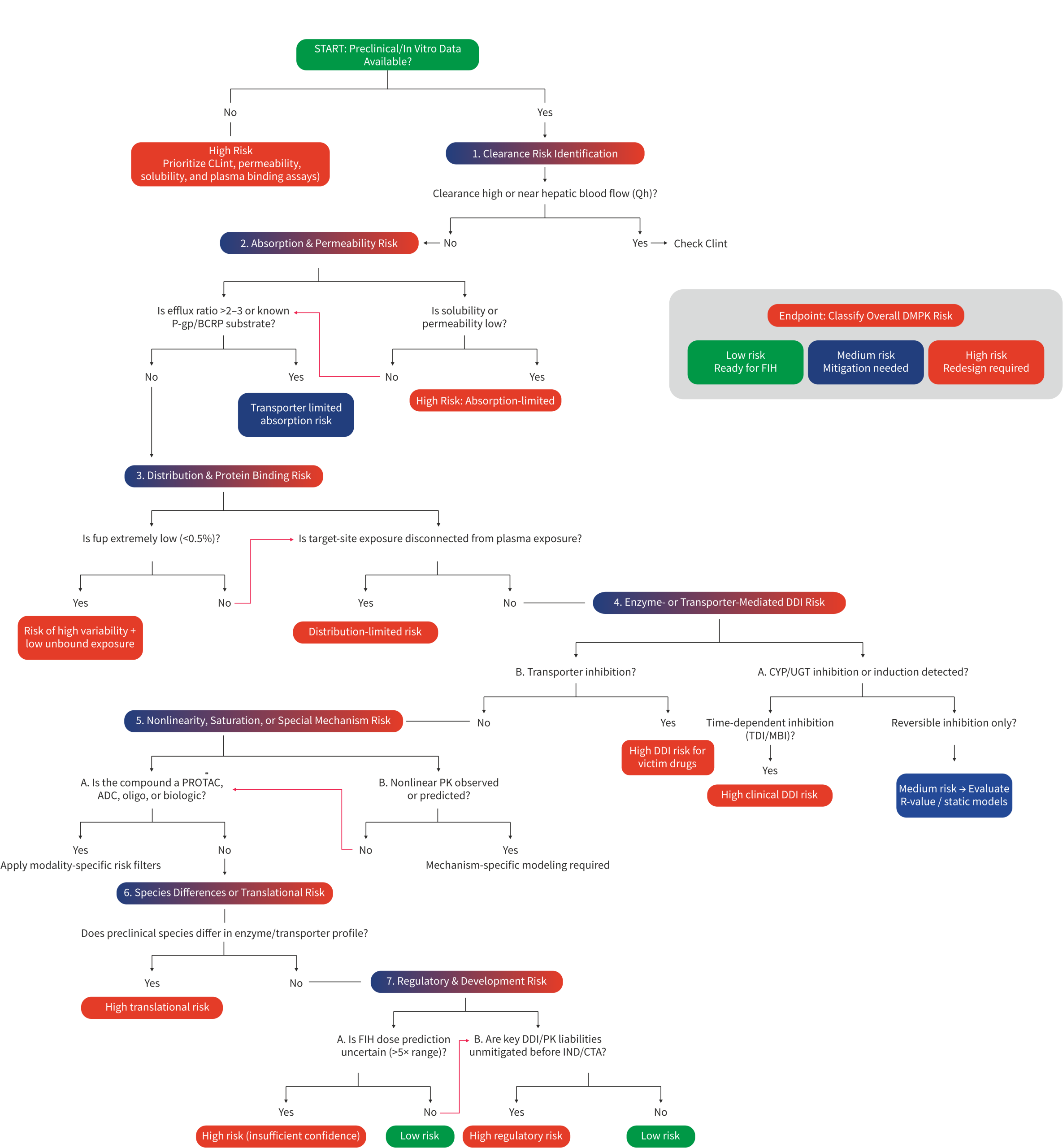
Figure 1: Unified DMPK Risk Flowchart. A consolidated, color‑coded risk map that organizes key DMPK liabilities across absorption, distribution, clearance, permeability, transporter effects, nonlinear kinetics, drug–drug interactions, and translational/regulatory factors. This framework bridges mechanistic understanding with development decision‑making for CRDMO programs. Green indicates “Low risk” and readiness for FIH progression; orange indicates “Medium risk” requiring targeted mitigation; red reflects “High risk” warranting chemical, mechanistic, or strategic redesign.
Intrinsic Clearance and Enzyme Kinetics
Hepatic clearance is governed by intrinsic metabolic capacity and hepatic blood flow, often described using well-stirred or dispersion models. Intrinsic clearance (CLint), measured in microsomes or hepatocytes, reflects enzymatic capacity independent of perfusion. Through in vitro–in vivo extrapolation (IVIVE), CLint can be scaled quantitatively to predict human hepatic clearance (CLh).
Mechanistic enzyme kinetics (Km, Vmax) distinguish flow-limited from capacity-limited clearance and enable prediction of nonlinear pharmacokinetics or time-dependent inhibition. Incorporating enzyme abundance and inter-individual variability further improves translational confidence. For CRDMOs, robust human clearance prediction supports rational first-in-human dose selection, reduces exposure-related surprises, and strengthens regulatory positioning from the outset.
Transporter–Enzyme Interplay
Drug disposition is rarely dictated by metabolism alone. Coordinated transporter and enzymatic processes frequently determine intracellular drug concentrations and systemic exposure.
Uptake transporters, efflux pumps such as P-gp and BCRP, and renal transporters can become rate-limiting steps in disposition. Mechanistic DMPK integrates transporter kinetics with metabolic clearance within compartmental frameworks that capture intracellular concentrations driving enzymatic turnover. This allows differentiation between permeability, transporter, or metabolism-limited clearance pathways.
Early identification of transporter-mediated liabilities reduces variability, informs DDI strategy, and enhances regulatory dialogue with a mechanistically justified risk assessment.
Physiologically Based Pharmacokinetic (PBPK) Modeling
PBPK modeling represents the most comprehensive expression of mechanistic DMPK. Unlike empirical scaling, PBPK integrates anatomical, physiological, biochemical, and compound-specific parameters to simulate systemic exposure under diverse clinical scenarios.
Drug movement among organs is described using differential equations parameterized by blood flows, tissue volumes, enzyme and transporter expression, and binding characteristics. Platforms such as Simcyp Simulator and GastroPlus allow:
Mechanistically validated PBPK models are now routinely incorporated into submissions to major regulatory agencies, reflecting the maturation of model-informed drug development (MIDD). PBPK modelling may be used to assess selected clinical scenarios and support development planning where scientifically appropriate.
Target-Site Exposure and Tissue Distribution
Total plasma concentration is often an imperfect surrogate for pharmacological effect. Only unbound drug at the site of action drives efficacy and toxicity.
Mechanistic DMPK therefore emphasizes:
Distribution models integrate physicochemical properties, ionization state, permeability, and transporter expression to estimate unbound target-site concentrations.
CNS programs incorporate blood–brain barrier penetration and efflux to predict unbound brain exposure. Oncology models account for tumor perfusion, diffusion, and binding kinetics. Aligning dose selection with exposure–response relationships — rather than empirical plasma thresholds — strengthens therapeutic window assessment and clinical strategy.
Extension to Biologics and Emerging Modalities
Mechanistic DMPK is essential for biologics and advanced modalities whose pharmacokinetics are governed by nonlinear, saturable, and intracellular processes rather than classical small-molecule ADME.
Monoclonal antibodies (mAbs) commonly exhibit target-mediated drug disposition (TMDD), where clearance depends on receptor binding, internalization, and FcRn recycling. For example, Trastuzumab demonstrates dose-dependent clearance driven by HER2 engagement, requiring models that incorporate target turnover, binding kinetics, and receptor trafficking to distinguish linear IgG catabolism from nonlinear target-mediated pathways.
Antibody–drug conjugates (ADCs) introduce multi-analyte complexity, as intact conjugate, released payload, and unconjugated antibody may independently drive efficacy and toxicity. Mechanistic models must integrate linker stability, drug–antibody ratio dynamics, intracellular processing, and payload metabolism, as exemplified by Ado-trastuzumab emtansine.
PROteolysis TArgeting Chimeras (PROTACs) operate via catalytic protein degradation rather than occupancy. ARV-110 links systemic exposure to intracellular ternary complex formation and target turnover, requiring integration of permeability, cooperativity, ubiquitination kinetics, and target resynthesis to predict degradation efficiency and hook effects.
Oligonucleotides and gene-modifying therapies require modeling of tissue uptake, endosomal escape, intracellular persistence, and RNA/protein turnover. For example, Patisiran shows rapid plasma clearance but prolonged hepatic activity, decoupling systemic PK from pharmacodynamic duration.
Across modalities, mechanistic DMPK provides a unified, biology-anchored framework to explain nonlinear behavior, link systemic exposure to intracellular pharmacology, optimize dose selection, and support translational and regulatory justification in increasingly complex therapeutic landscapes.
Mechanistic DMPK translates chemical structure into predicted human exposure. Lipophilicity, polarity, and ionization are balanced against metabolic stability and tissue distribution. Solubility-limited absorption can be incorporated into PBPK frameworks to evaluate salt selection, particle engineering, amorphous dispersions, or modified-release strategies. By linking formulation attributes to predicted systemic exposure, mechanistic DMPK ensures alignment among medicinal chemistry, CMC strategy, and clinical pharmacology — reducing bioavailability risk and improving development -outcomes.
Regulatory expectations increasingly demand quantitative justification for:
Mechanistic DMPK integrates physiological variability with compound-specific kinetics to support IVIVE-based clearance prediction, mechanistic DDI simulations, and PBPK-informed labeling strategy.
For sponsors and CRDMOs alike, this approach supports the generation and interpretation of pharmacokinetic evidence, providing scientific rationale that can inform regulatory submissions and development decision-making.
Mechanistic DMPK transforms ADME data into actionable development decisions — de-risking the path to clinic and commercialization.
A high performing mechanistic DMPK capability aligns wet lab throughput, quantitative modeling, and regulatory science into a single operating picture.
Mechanistic DMPK provides a rigorous translational framework linking molecular design to systemic and tissue exposure across small molecules, biologics, ADCs, PROTACs, and gene-modifying therapies. Through enzyme kinetics, transporter modeling, IVIVE, PBPK simulation, and systems pharmacology integration, it explains why exposure behaves as observed — and predicts human pharmacokinetics with confidence.
For CRDMOs, embedding advanced mechanistic DMPK capabilities is not merely a technical enhancement; it is a strategic differentiator. By strengthening translational precision, regulatory alignment, and development efficiency, mechanistic DMPK increases the probability that innovative molecules successfully advance from discovery to the clinic.
Aragen offers an end‑to‑end mechanistic DMPK engine that unifies high‑quality in vitro assays, translational IVIVE, and regulatory‑ready PBPK modeling to optimize druggability with precision. With deep expertise across small molecules, biologics, ADCs, and emerging modalities, Aragen translates complex ADME data into actionable insights that de‑risk clearance, DDI, and exposure challenges early. This integrated CRDMO approach supports informed decision-making, contributes to development readiness activities and provides scientific evidence to support programme progression.
