
GET IN TOUCH
Case Study

Optimized SPR-Based Screening of RNA-Targeting Small Molecules

Overview

RNA-binding small molecules are gaining interest as therapeutics owing to RNA’s critical role in gene regulation and disease. However, their discovery requires precise characterization of RNA-ligand interactions, which is complicated by RNA’s inherent structural flexibility, chemical instability, and sensitivity to handling conditions. To meet these challenges, sensitive and reliable biophysical techniques are essential for maintaining RNA’s native conformation and accurately measuring binding events.

Surface Plasmon Resonance (SPR) offers a suitable biophysical technique that enables real-time, label-free analysis of RNA interactions with minimal sample consumption. However, successful application of SPR to RNA targets demands optimized assay conditions that preserve RNA stability and structure during immobilization and measurement. The primary challenges lie in maintaining biologically relevant folding, preventing degradation, and immobilizing RNA without compromising its functional integrity.

This case study illustrates how Aragen’s experts leveraged SPR to address key challenges in RNA-based SPR analysis, enabling precise kinetic profiling and identification of the most suitable high-affinity RNA-binding small molecule.

Challenges

  • Structural dynamics and refolding: RNA molecules are highly dynamic and prone to refolding, especially once removed from their native cellular environment. This conformational flexibility can complicate reproducible immobilization on the SPR sensor surfaces. Maintaining the RNA’s correct, biologically relevant structure under optimal conditions is essential for accurate and reliable binding analysis.
  • RNA stability: Compared to other biomolecules like DNA and proteins, RNA is chemically less stable and highly susceptible to degradation by nucleases and hydrolysis. Protecting RNA integrity during experiments requires rigorous RNase-free handling and carefully controlled experimental conditions to prevent its degradation.
  • Immobilization without perturbation: Immobilizing RNA onto SPR sensor surfaces without altering its native structure and function poses a significant challenge. Immobilization methods such as biotin-streptavidin capture must minimize structural disruption while ensuring consistent orientation and accessibility of the RNA for reliable interaction studies.

Aragen’s Solutions

The experiment was performed using an advanced SPR platform. The laboratory was rigorously decontaminated to maintain an RNase-free environment, ensuring the integrity of RNA samples, and preventing degradation.

  • RNA refolding: Prior to immobilization, biotinylated RNA was refolded under optimized, nuclease-free conditions to ensure it adopted its natural, biologically relevant structure. This step is essential for maintaining the RNA’s native conformation, which is crucial for accurate analysis of its interactions with small molecules.
  • Immobilization and small molecule screening: The refolded RNA was non-covalently immobilized onto a streptavidin (SA)-coated SPR sensor chip, promoting uniform orientation across the sensor surface. Small molecules were injected at varying concentrations over both the flow cell containing the immobilized RNA target and a reference cell with either non-binding RNA or no immobilized biomolecule. This setup allowed specific binding signals to be distinguished from non-specific interactions.
  • Data analysis and kinetic modelling: SPR sensorgrams were processed using the Biacore T200 Evaluation Software. Data were double-referenced and fitted to a 1:1 Langmuir binding model to extract kinetic parameters, including association (ka) and dissociation (kd) rates, as well as equilibrium dissociation constants (KD) to quantify binding strength

Outcome

Multicycle kinetics (MCK) experiments successfully measured the binding affinities of various potential small molecules to the target RNA using the Biacore T200 platform. The team successfully utilized this approach to characterize a range of interactions, with the binding data for one of the most potent compounds presented in Figure 1, illustrating its detailed kinetics and binding affinity. 
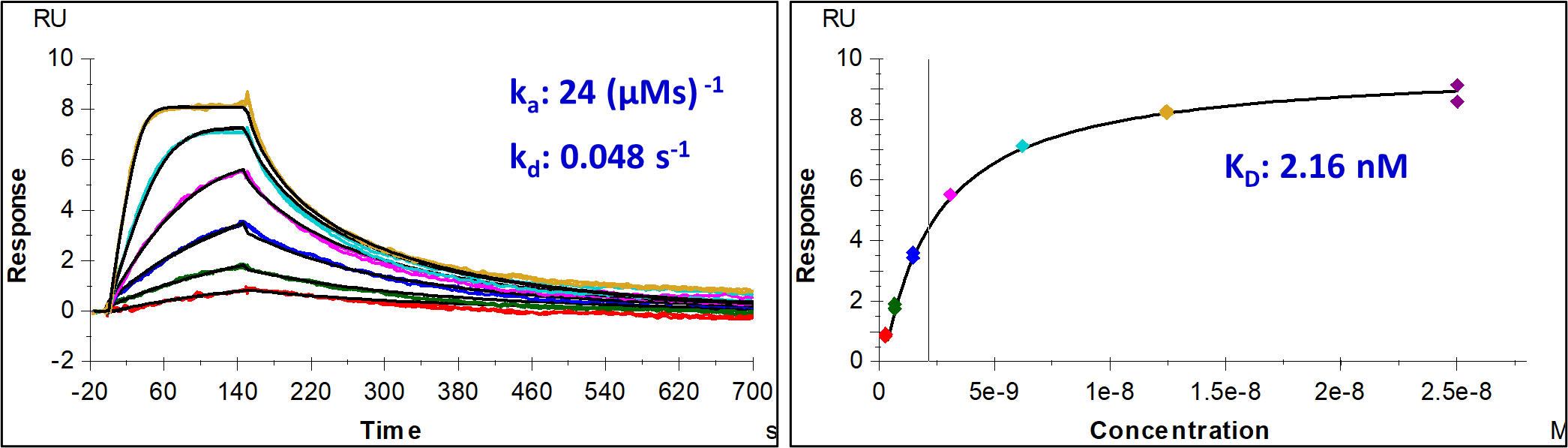
These results clearly demonstrate how Aragen’s SPR expertise, combined with experience in tailored handling of RNA-based samples, enables precise screening and detailed characterization of RNA-binding compounds. The approach applied herein is suitable to overcome the inherent challenges of RNA stability and folding, enabling more reliable and insightful RNA-targeted drug discovery at early stages.

Why Aragen?

With a decade of SPR expertise, we accelerate drug development by providing trusted insights that optimize drug candidate profiling and efficacy. We offer:

  • Broader SPR Proficiency: Experienced working with various biomolecules—small molecules, proteins, RNA—and across different drug modalities to support your discovery needs.
  • Extensive Expertise: Skilled in SPR-based studies of RNA-small molecule interactions, including binding characterization, kinetic analysis, RNA-ligand screening, and competition assays tailored for RNA targets and more.
  • High-Quality Data: Delivering accurate, reproducible binding and kinetic data to support confident drug development decisions.
  • Customized Solutions: Providing tailored SPR services—from drug competition assays to quality control—designed to meet your specific R&D objectives.