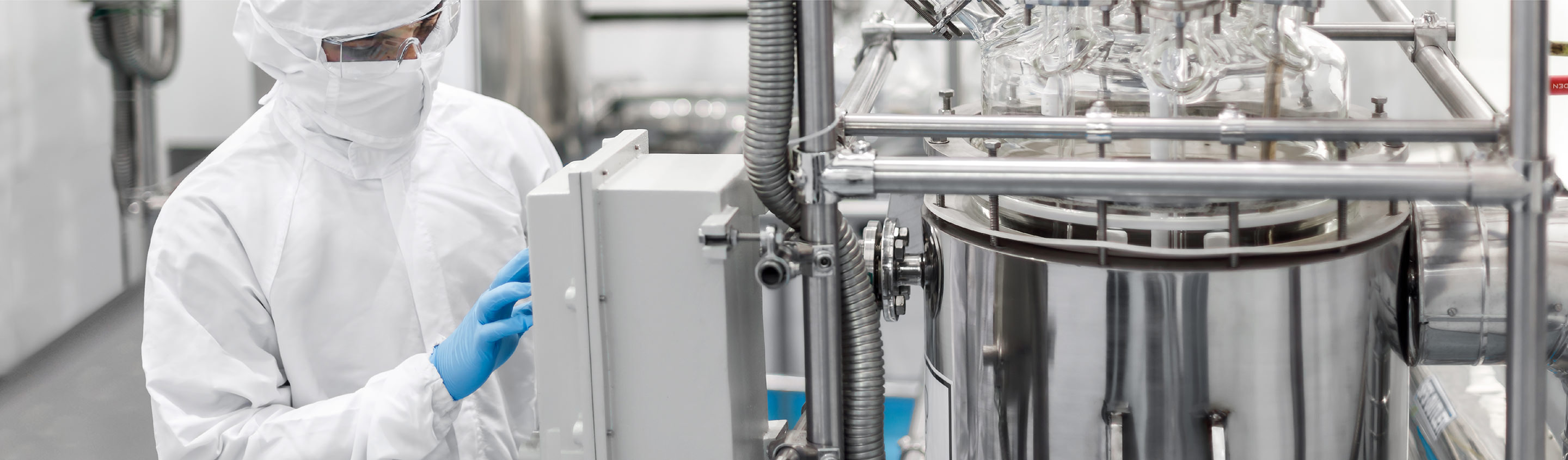

Commercial manufacturing performance is determined long before the first validation or commercial batch is produced. Decisions made during process development influence process robustness, product quality, regulatory readiness, supply continuity, and manufacturing economics throughout a product’s lifecycle. While often associated with route optimization and scale-up, process development is fundamentally about designing a manufacturing-ready process.
This whitepaper examines how decisions around manufacturability, process understanding, quality, safety, and lifecycle economics influence commercial manufacturing outcomes, and why a manufacturability-first approach reduces risk, accelerates technology transfer, and supports long-term operational performance.
Many manufacturing challenges emerge during scale-up, validation, or technology transfer, but their origins often lie in development.
A process that performs well in the laboratory may encounter challenges related to impurity control, safety, scalability, operational efficiency, or supply continuity as manufacturing demands increase. As timelines compress and molecules become more complex, success can no longer be measured by yield or synthetic feasibility alone.
Modern process development establishes the scientific and operational foundation for manufacturing by generating process knowledge, defining control strategies, mitigating risks, and ensuring scalability. As a result, it has evolved from a supporting activity into a critical driver of commercial success.
Route scouting remains a foundational element of process development, but successful commercialization requires a broader perspective.
Today’s programs must consider process safety, impurity control, analytical readiness, scalability, supply chain resilience, and operational efficiency alongside synthetic feasibility. The objective is not merely to identify a viable route but to establish a process that can consistently deliver quality, performance, and reliability throughout its lifecycle.
At Aragen, this approach is supported through integrated capabilities spanning route scouting, process optimization, process safety assessments, HAZOP studies, salt and polymorph screening, analytical sciences, and quality-by-design principles.
Designing for Manufacturability
The earliest development decisions often have the greatest impact on long-term manufacturing performance.
A route that achieves high laboratory yields may depend on hazardous reagents, unstable intermediates, challenging separations, or limited raw material availability. While manageable during development, these factors can significantly affect manufacturing efficiency, safety, and cost competitiveness.
Manufacturability-focused route selection evaluates synthetic options using criteria that extend beyond chemistry, including safety, environmental impact, process control, scalability, economics, and supply-chain considerations. This aligns development objectives with future commercial requirements from the outset.
Building Process Understanding and Robustness
Commercial manufacturing requires a clear understanding of how process variables influence product quality and performance.
As reactions move from laboratory equipment to pilot and commercial-scale reactors, changes in heat transfer, mixing, mass transfer, and reaction kinetics can affect conversion, selectivity, and impurity profiles. Understanding the relationship between critical material attributes (CMAs), critical process parameters (CPPs), and critical quality attributes (CQAs) enables the development of effective control strategies and well-defined design spaces.
This knowledge helps reduce process variability, support validation activities, and facilitate smoother technology transfer into manufacturing.
Building Quality into the Process
Product quality begins with process design.
Impurity formation, impurity purge mechanisms, crystallization behavior, and analytical control strategies must be understood early to support a robust quality profile. Addressing these factors during development reduces the likelihood of manufacturing deviations, regulatory concerns, and costly process modifications later in the product lifecycle.
Equally important is the integration of analytical development with process development. Analytical methods must evolve alongside the process to support optimization, technology transfer, validation, and commercial manufacturing. Increasing industry focus on analytical readiness during scale-up reflects the importance of this alignment.
Engineering Safety into the Process
Process safety is a key enabler of manufacturing reliability.
Processes involving highly exothermic reactions, hazardous reagents, gas evolution, or unstable intermediates often require extensive controls during commercial operation. Addressing these risks early allows development teams to determine safer operating conditions, evaluate alternative process options, and reduce operational complexity.
Comprehensive safety assessments, including thermal hazard evaluation and HAZOP studies, help ensure that safety becomes an integral part of process design rather than a constraint addressed later during manufacturing. This ultimately contributes to more predictable and efficient commercial operations.
Optimizing for Lifecycle Economics
Commercial success depends on more than process yield.
Cost of goods is influenced by multiple factors, including raw material sourcing, solvent and reagent consumption, waste generation, cycle time, throughput, and equipment utilization. Optimizing a process for one parameter alone rarely produces the best commercial outcome.
Development teams must therefore evaluate processes through a lifecycle lens. Opportunities such as process intensification, telescoping, solvent recovery, alternative sourcing strategies, and backward integration can significantly improve long-term manufacturing performance. This broader perspective helps organizations balance technical excellence with economic sustainability.
Scale-up is often viewed as the ultimate objective of process development. In practice, it is the outcome of successful development.
When process understanding is robust, impurities are controlled, safety risks are characterized, and manufacturing considerations are incorporated early, scale-up becomes significantly more predictable. The objective is not simply to increase batch size but to maintain consistent quality and process performance as manufacturing demands evolve.
Processes that transition successfully into commercial manufacturing are typically those that have been engineered for commercial readiness from the start.
At Aragen, process development is guided by the principle that commercial manufacturing requirements should influence development decisions from the earliest stages of a program.
By integrating route scouting, process optimization, analytical sciences, process safety, scalability assessment, and quality-by-design methodologies within a single framework, Aragen helps clients design processes that are scientifically robust and commercially sustainable. Rather than treating development and manufacturing as distinct phases, the focus is on creating a seamless pathway from laboratory chemistry to commercial production.
Commercial manufacturing performance is established during process development, not during validation or launch. Decisions related to route design, process understanding, quality strategy, safety, and lifecycle economics collectively determine whether a process can be manufactured consistently, efficiently, and competitively at scale. Organizations that embed manufacturability and commercial readiness into development strategies are better positioned to accelerate commercialization, strengthen supply resilience, and reduce long-term manufacturing risk. In today’s pharmaceutical landscape, process development is no longer preparation for commercial manufacturing. It is where commercial manufacturing is designed.
Have a molecule moving toward scale-up or commercialization? Connect with Aragen’s experts to discuss how an optimized process development strategy can help accelerate your path to market.
