
Building Continuity from High-Potent Development to GMP Supply
Moving a high-potent molecule from development to reliable GMP supply depends on continuity: the process knowledge, containment strategy, and analytical understanding built during development must carry through to manufacturing. With timelines compressing, development and manufacturing can no longer be treated as independent activities.
That continuity is harder to achieve with high-potent programs, because their demands go well beyond those of conventional development. Containment, analytical sensitivity, process robustness, material handling, and operator safety must be built into every stage. Decisions made during development can shape manufacturing feasibility, regulatory readiness, and supply reliability months or years later. With timelines compressing, development and manufacturing can no longer be treated as independent activities.
GMP Readiness Begins During Development
GMP readiness is often seen as a manufacturing milestone, but it is established throughout development. For high-potent compounds and payloads, it requires confidence that containment strategies are appropriate, analytical methods can support future control strategies, impurity profiles are well understood, appropriate detoxification method is developed, and the process performs consistently under GMP conditions. When these factors are integrated early, GMP manufacturing becomes a natural progression. When addressed late, they become sources of delay, rework, higher cost, and technology-transfer risk.
Development Decisions Shape Manufacturing Success
The foundations of successful high-potent manufacturing are established long before a GMP batch is produced. Route selection, purification strategies, impurity control, process parameters, and material-handling approaches are often optimized for development milestones. Yet these same choices determine whether a process can be scaled safely and efficiently in a high-containment environment. A purification strategy that works well in development may struggle in an OEB-controlled setting, and conditions that seem robust at laboratory scale may behave differently with larger equipment, closed-processing systems, and enhanced containment. Evaluating these factors early keeps processes scalable, controllable, and manufacturing-ready.
Figure 1 illustrates how key development decisions collectively influence manufacturing readiness for high-potent molecules.
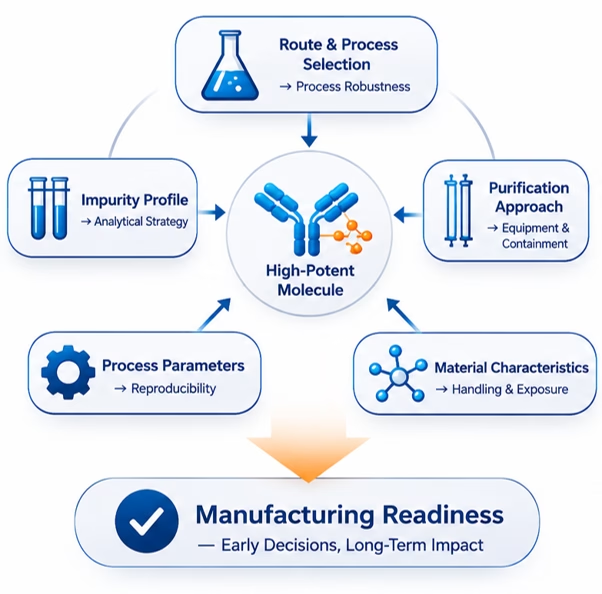
Figure 1: Development decisions that shape high-potent manufacturing readiness
Why an Integrated Approach Matters
High-potent programs require decisions to be weighed through several interconnected lenses— process development aligned with containment, analytical methods suited to sensitive detection, and material handling that protects both product quality and personnel. For linker-payloads, stability, purification, compatibility, and conjugation suitability add further complexity. When these disciplines work in silos, solving one problem can create another. An integrated approach lets teams evaluate risks holistically and resolve them earlier.
Scale-Up Is About More Than Bigger Batch Size
For high-potent compounds and payloads, scale-up is not simply a matter of producing more material. As processes approach GMP production, containment performance, equipment compatibility, cleaning strategies, waste management, operator exposure control, and reproducibility grow critical. Small variations that matter little in development can affect efficiency, quality, and GMP readiness at scale. Programs that consider scale-up early are better positioned to anticipate these challenges before technology transfer or commercial preparation.
From Process Understanding to Supply Confidence
Reliable GMP supply is the outcome of accumulated process understanding, including process behavior, impurity trends, analytical performance, scalability, containment needs, and control strategy. Its value depends on staying connected to the program throughout its lifecycle. When development, scale-up, and manufacturing operate within a continuous framework, knowledge is retained and applied, delivering greater predictability, better execution, lower operational risk, and higher confidence in clinical and commercial supply.
Is Aragen’s OneHP the Solution?
For high-potent compounds, payloads, linkers, and linker-payloads, continuity can be the difference between a process that succeeds in development and one that consistently delivers in a GMP environment.
Aragen’s OneHP platform is built around this principle. By integrating high-potent development, process chemistry, analytical sciences, containment expertise, scale-up, and GMP manufacturing within a connected ecosystem, OneHP helps ensure that critical process knowledge is retained throughout the lifecycle of a program.
Figure 2 depicts the OneHP integrated ecosystem supporting high-potent programs across development and manufacturing.
The platform supports high-potent compounds, linkers, payloads, and linker-payloads from early development through multi-kilogram GMP supply, enabling development and manufacturing teams to work from a shared foundation of process understanding.
The objective is not simply to move a molecule from one milestone to the next. It is to ensure that process understanding, manufacturing readiness, containment strategy, and supply objectives advance together. As high-potent therapeutics continue to grow in complexity, this continuity is increasingly becoming a prerequisite for delivering reliable GMP supply with confidence.
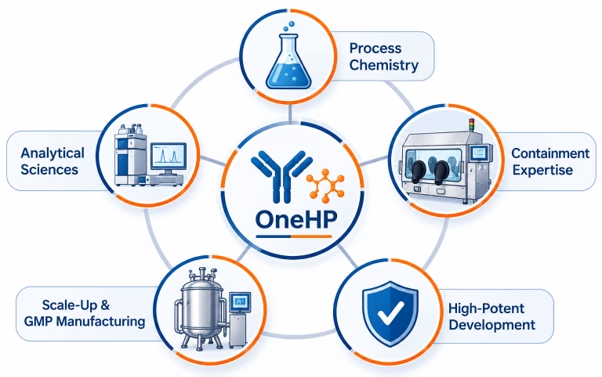
Figure 2: Aragen’s OneHP integrated ecosystem for high-potent development, containment, scale-up, and GMP manufacturing
Build GMP success into your high-potent program from day one.
Explore how Aragen’s OneHP platform integrates development, scale-up, containment, and GMP manufacturing to reduce risk, accelerate readiness, and strengthen supply confidence.
Reviewed by

General Manager – Production (HPAPI), Hyderabad
Aragen Life Sciences

Principal Scientist, Aragen Life Sciences
