

In pharmaceutical development, speed has become an increasingly important measure of success. The urgency to advance promising molecules into clinical evaluation is understandable. Every additional month of development carries scientific, financial, and competitive implications. Yet, there is a fundamental distinction between accelerating development and merely compressing activities.
Moving faster does not necessarily mean developing better. In fact, poorly informed decisions made early can create scientific and operational challenges that emerge much later, when correcting them becomes significantly more expensive and time-consuming.
The real opportunity lies in recognizing that speed and scientific rigor are not competing priorities. When applied intelligently, science is one of the most powerful enablers of speed.
This requires us to rethink how we approach early-phase drug product development, not as a sequence of technical activities, but as an interconnected journey of scientific decision-making.
Every molecule presents a unique development challenge. Some possess favorable physicochemical characteristics and lend themselves to relatively straightforward formulation approaches (CMC-enabling). Others exhibit poor aqueous solubility, challenging solid-state properties, instability, or unfavorable biopharmaceutical behavior (CMC-challenging).
Applying a uniform development template across all molecules can lead to unnecessary experimentation in some cases and insufficient scientific understanding in others. The purpose of preformulation and material science is not simply to generate characterization data. It is to translate molecular properties into actionable formulation decisions.
Understanding solid-state behavior, solubility across relevant physiological conditions, dissolution characteristics, permeability, and stability enables development teams to distinguish between challenges that genuinely require intervention and those that can be addressed through simpler approaches.
An equally important consideration is identifying which uncertainties must be addressed immediately and which can reasonably be deferred as the program advances. This distinction is fundamental to efficient development. The objective is not to characterize everything before proceeding, but to understand the right attributes well enough to make a scientifically sound decision.
One of the most consequential decisions in early development is selecting an appropriate drug product strategy. It can be tempting to approach complex molecules through the lens of available formulation technologies, such as amorphous solid dispersions, particle size reduction, lipid-based systems, nanosuspensions, and other enabling approaches.
These technologies have considerable value. However, their application should be driven by the clinical question being addressed and the intended study design and development objectives, rather than by technological capability alone. The intended clinical dose, exposure requirements, dose-escalation strategy, patient population, route of administration, and duration of treatment should collectively inform the formulation pathway.
For certain molecules, a simple solution, suspension, or drug-in-capsule (DiC) approach may be entirely adequate to establish early human exposure and proof of concept. For others, a conventional tablet or film-coated tablet, or capsule formulation may be sufficient. In some cases, however, an enabling formulation may be essential even for the first clinical study. The scientific judgment lies in knowing the difference. Hence, a technologically sophisticated formulation is not inherently a better formulation if it adds complexity without delivering corresponding clinical value.
Further, the best early-stage formulation is not always the most advanced one. It is the one that most effectively answers the next critical clinical question.
Additionally, collaboration among material scientists, preformulation and formulation scientists, discovery teams, DMPK specialists, toxicologists, and clinical development teams, ideally before a formulation strategy becomes deeply embedded in the program is also important.
The term phase-appropriate development is widely used in pharmaceutical R&D, but its interpretation deserves greater attention. It should not be confused with compromising quality, overlooking critical risks, or accepting poorly understood processes. Rather, it represents a disciplined approach to applying scientific rigor in proportion to the maturity, uncertainty, and intended clinical use of a drug product.
The phase-appropriate philosophy extends from formulation selection to analytical method development and regulatory strategy.
At the first-in-human stage, the priority is to deliver a product with appropriate quality, safety, stability, and dose reproducibility, supported by a scientifically justified control strategy. As a molecule progresses through clinical development, greater emphasis shifts toward formulation robustness, process understanding, scalability, manufacturability, and evolving regulatory expectations.
Attempting to resolve every commercial manufacturing consideration during early clinical development can introduce unnecessary complexity. Conversely, ignoring foreseeable downstream challenges can create costly redevelopment efforts and comparability requirements.
The challenge is therefore not simply deciding what to develop, but determining what must be established now, what should be anticipated, and what can be progressively strengthened as evidence accumulates. This is where scientific experience, risk assessment, and development strategy must converge.
Early clinical development is inherently dynamic, with the following new information emerging continuously.
A rigid formulation strategy may struggle to accommodate these changes without significant redevelopment. Where scientifically feasible, formulation and manufacturing approaches should maintain sufficient flexibility to support dose adjustments, evolving clinical requirements, and future process development. However, flexibility should not become an excuse for repeated formulation changes without sound scientific justification. There is an important distinction between designing for adaptability and accepting avoidable variability.
Similarly, early formulation choices should be made with an understanding of the likely development trajectory. A formulation that supports first-in-human dosing but creates disproportionate challenges during later development may not represent the fastest overall pathway. This calls for a balanced perspective: optimize for the next clinical milestone while remaining mindful of those that follow. The right decisions preserve future options without burdening the present with unnecessary complexity. This balance between addressing immediate clinical requirements and preserving future development options is central to a phase-appropriate development strategy (Figure 1).
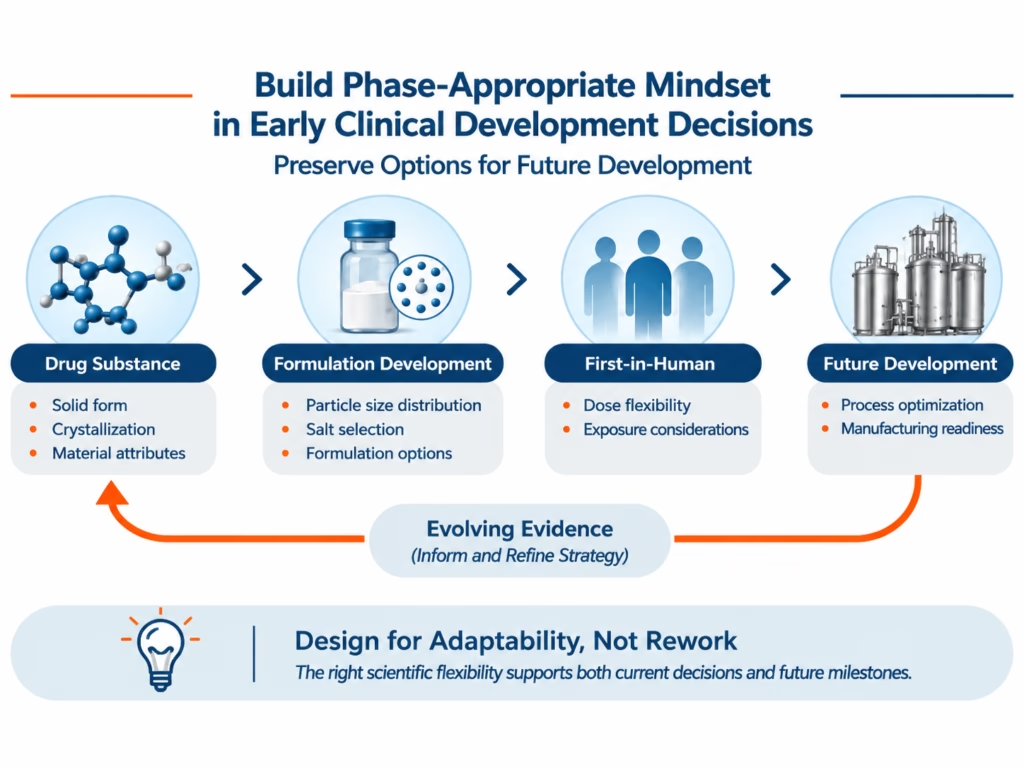
Figure 1: Phase-appropriate development decisions. Maintaining flexibility as scientific evidence evolves, while preserving options for future clinical and manufacturing development.
Development programs rarely lose time because of a single scientific activity. More often, delays emerge at the interfaces between disciplines. A late change in solid form can affect formulation stability. An incomplete understanding of drug substance material attributes can complicate scale-up. Analytical methods that are insufficiently mature can delay batch release. Manufacturing constraints identified too late can necessitate process redesign.
Ultimately, these are not merely project management challenges. They are often the result of decisions being made without adequate visibility across the broader development pathway.
The advantage of integrating material science, formulation development, analytical sciences, process engineering, quality, and GMP manufacturing within a connected development framework extends far beyond operational efficiency. When these functions operate with a shared understanding of development objectives and constraints, risks can be identified earlier, and informed decisions can be made with greater confidence.
Technology transfer, in particular, should not be viewed as a late-stage documentation exercise. Rather, manufacturing feasibility, equipment compatibility, material attributes, and process sensitivity should inform development decisions well before the first clinical GMP batch.
In this context, what matters is not the mechanical completion of predefined activities, but confidence that the process can reliably deliver the intended product. Integration creates value when it improves the quality and timing of scientific decisions, not simply when activities are performed within the same organizational structure.
An efficient development strategy identifies the uncertainties most likely to influence the next clinical or technical decision and designs experiments to address them with minimal unnecessary effort.
This requires moving beyond activity-based measures of progress. The number of formulations screened, experiments completed, or reports generated does not necessarily indicate how effectively a program is advancing.
More meaningful questions include:
This mindset transforms experimentation from a collection of tasks into a purposeful sequence of decisions. It also challenges scientists and leaders to recognize when sufficient evidence exists to move forward rather than pursuing technical perfection beyond what the development stage requires.
The journey from a promising molecule to first-in-human evaluation will always involve scientific uncertainty, evolving information, and difficult choices. No universal development pathway can eliminate these challenges. What differentiates effective development strategies is the ability to combine deep scientific understanding with clinical relevance, pragmatic risk management, and disciplined execution.
The objective is neither to accelerate every activity nor to generate the maximum amount of scientific information. It is to generate the right evidence, make the right decisions at the right time, and avoid creating problems that could have been anticipated earlier.
For those working at the intersection of pharmaceutical science and drug development, this represents an important shift in mindset. Speed should not come at the expense of science. Speed should be the consequence of applying science intelligently.
Perhaps that is the most meaningful definition of phase-appropriate development.
Connect with Aragen’s experts to reduce risk and accelerate your molecule’s journey to the clinic.
Reviewed by