
Direct-to-Biology (D2B) library platforms are transforming how hit identification is approached in modern drug discovery. Traditional workflows require compounds to progress through synthesis, purification, characterization, and biological testing before meaningful insights can be generated. While scientifically rigorous, these sequential steps can slow iteration, particularly when hundreds or thousands of analogs must be evaluated to establish structure-activity relationships (SAR).
By integrating high-throughput synthesis, analytical assessment, and biological screening within automation-enabled Design–Make–Test–Learn (DMTL) workflows, this approach significantly shortens the path from molecular design to biological data. The result is faster hit identification, earlier SAR generation, and more efficient progression of discovery programs.
More importantly, the value of D2B extends beyond speed. By enabling earlier identification of promising chemotypes and faster elimination of unproductive hypotheses, it shifts the focus from compound processing to knowledge generation, helping discovery teams make better-informed decisions and accelerate the path to validated hits.
D2B represents a fundamental shift in how early discovery campaigns are executed. Rather than relying on multiple handoffs between synthesis and screening, compounds are generated through parallel, miniaturized workflows and rapidly advanced into biological assays.
In many implementations, crude or minimally processed reaction products are screened before conventional purification, providing biological feedback much earlier in the discovery process. Promising compounds can then be resynthesized and fully characterized for follow-on studies.
This approach enables researchers to evaluate a broader range of scaffolds, substitution patterns, stereochemical variants, and molecular architectures while focusing resources on compounds that have already demonstrated biological relevance. The result is faster learning and more efficient progression through early discovery.
The growing adoption of D2B has been enabled by advances in laboratory automation, miniaturized chemistry, analytical technologies, and high-throughput screening.
Automated liquid handling, plate-based parallel synthesis, integrated analytical workflows, and miniaturized assays now allow researchers to generate and evaluate thousands of compounds within compressed timelines. Reactions performed at microscale reduce reagent consumption while significantly expanding the number of compounds that can be tested in a single campaign.
At Aragen, automation-enabled D2B workflows leverage advanced liquid-handling platforms, integrated analytical capabilities, and high-density reaction formats to support both focused SAR campaigns and multi-thousand-compound library generation. Beyond throughput, automation improves reproducibility, data quality, and integration across chemistry, analytics, and biology.
Today, D2B is an established component of modern hit-identification strategies, enabling faster learning through the integration of automation, high-throughput chemistry, analytical sciences, and biological screening within accelerated DMTL cycles.
However, successful D2B implementation requires more than synthesis throughput alone. It depends on the coordinated integration of miniaturized chemistry, automated liquid handling, analytical characterization, assay-ready screening workflows, and rapid data interpretation. Together, these capabilities ensure that biological insights can be generated quickly without compromising data quality or decision confidence.
At Aragen, D2B capabilities are supported by automation-enabled library synthesis, integrated analytical workflows, and assay biology expertise. Through flexible workflows tailored to specific program needs, Aragen helps clients explore broader chemical space, generate actionable SAR insights, and accelerate progression from molecular hypothesis to validated hit series.
Effective D2B strategies balance throughput with analytical confidence and biological interpretability. Modern D2B platforms offer multiple approaches, from direct screening workflows that maximize speed to quantified D2B approaches that incorporate analytical assessment for greater confidence in screening results. Purification-enabled workflows provide additional rigor when biological evaluation requires a higher degree of certainty.
At Aragen, these strategies are tailored to target biology, assay requirements, and project objectives. Integrated LC-MS characterization and quantitative analytics help ensure that accelerated timelines are supported by reliable, decision-ready data.
Many discovery programs require the evaluation of hundreds or even thousands of analogs before meaningful SAR patterns emerge. Conventional workflows can constrain how much chemical diversity can be explored within practical timelines.
D2B eliminates many of these limitations by enabling rapid synthesis and screening of larger, more diverse compound collections. Researchers can evaluate a wider range of scaffolds, stereochemical variants, exit vectors, and substitution patterns, increasing the likelihood of identifying productive chemical matter.
As the breadth of chemical exploration increases, the ability to generate and interpret high-quality data becomes equally important. Larger, well-designed datasets often reveal SAR trends earlier, helping teams prioritize promising directions and make more confident discovery decisions. At Aragen, automation-enabled library synthesis and integrated screening workflows support this process by enabling rapid exploration of diverse chemical space and generation of actionable SAR insights.
The success of a D2B strategy depends on the effective integration of medicinal chemistry, automation, analytical sciences, screening biology, and scientific interpretation. Without these capabilities working together, gains in throughput do not necessarily translate into better discovery outcomes.
Integrated discovery environments enable seamless progression from library design to biological insight, accelerating Design–Make–Test–Learn cycles and improving decision-making.
Aragen’s D2B capabilities are embedded within an integrated discovery framework that combines automation-enabled library synthesis, analytical characterization, assay biology, and rapid SAR evaluation. This connected ecosystem enables researchers to generate high-quality biological data, explore broader chemical space, and accelerate progression from hit identification to lead optimization.
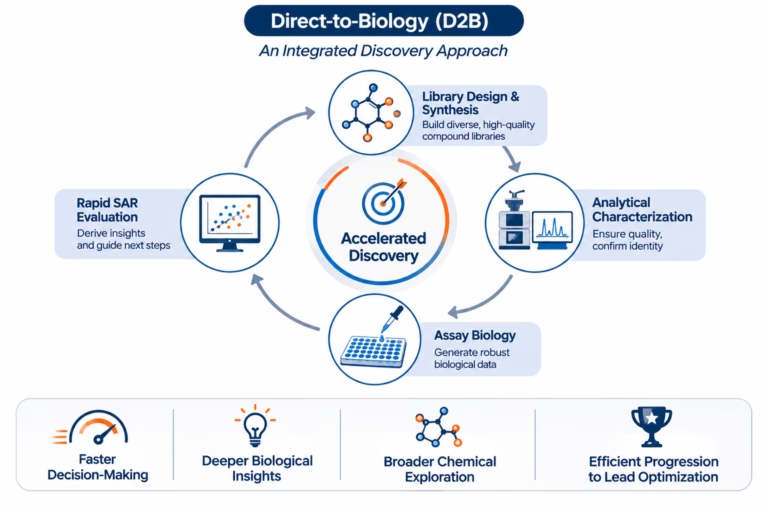
Figure 1: Direct-to-Biology integrates library synthesis, analytical characterization, biological screening, and SAR evaluation into a connected discovery workflow, enabling faster learning and more informed decisions.
As drug discovery programs seek to explore larger chemical spaces within compressed timelines, Direct-to-Biology has become a valuable approach for accelerating early discovery. By integrating synthesis, analytics, and biological screening into streamlined, automation-enabled workflows, D2B increases the speed at which meaningful biological knowledge is generated. This enables discovery teams to make smarter decisions earlier, prioritize the most promising chemical series, and advance high-quality candidates more efficiently toward lead optimization.
Talk to Aragen’s discovery experts about leveraging Direct-to-Biology workflows to generate actionable biological insights, explore broader chemical space, and advance promising programs faster.
Reviewed by